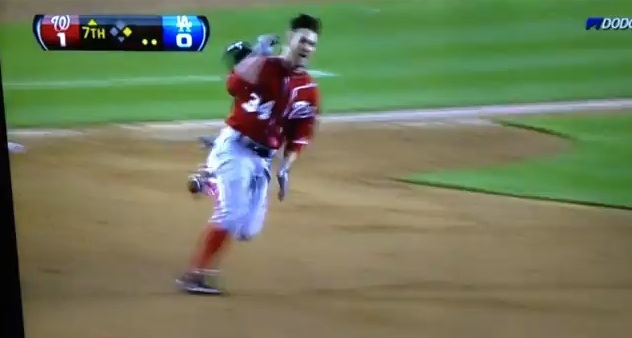
I’ve slugged the most doubles
I’ve hit almost as many
As stars seen by Edwin Hubble
People tend to rate me
Four boring jobs. Four bored idiots. Witness the workday ramblings of a quartet of morons breaking the chains of tedium before nipping off to the pub. Atop Mount Drinkmore, every hour is Happy Hour.

So, it is entirely possible that Robin Williams possessed
great baseball potential, even if he never sensed it. However, the world is a
better place for him taking the route that he did—not only because he left a
legacy of laughter, but because Williams’ natural inclination to field a batted
ball, then toss it in the air while declaring, “Fly, be free!” would have led
to a catastrophic amount of unearned runs…
It occurred to me several days after we were eliminated that I could have taken the opportunity after at least one of those Ball Four's to yell at the opposing pitcher a Ratso Rizzo–esque "I'm walkin' here!" while running to first base. This most famous quote from Midnight Cowboy—and its accompanying profanities and obscene gestures—likely would have unsettled the pitcher, providing us a chance for a big inning that may well have swung the series in our favor. Ultimately, I don't think I can be faulted for failing to try this tactic...but you can be sure I'm going to study it all winter and practice my "Ratso" intently during spring training so I'll have it ready for Opening Day 2013! 
Just 17 home runs shy of 600—still the rarefied realm of only Hank Aaron, Babe Ruth, and Willie Mays in 2001—and owed $30 million on a contract extension, Mark McGwire received plaudits for limping away from baseball on his own terms. Hindered by bad knees, he still smashed 29 round-trippers in his swansong season, remaining a productive and popular player. Little did we know that McGwire’s exit was a less-than-virtuous getaway from the steroid scandal about to break—a lie that he lived for a decade, until finally confessing last year.
Like McGwire and Barry Bonds, whose bodies ballooned during the steroid era, LaRussa began tipping the scales (albeit less dramatically). His 1981 Fleer baseball card, issued three years into his managerial career, listed LaRussa at 185 lb; however, Baseball Almanac currently denotes him at 190 lb. Sure, this shocking transformation of his body could result from weightlifting—as asserted the unrepentant Bonds—but let’s not kid ourselves.
A 19-inning marathon between the Philadelphia Phillies and Cincinnati Reds ended at 1:19 this morning, with 2nd-baseman Wilson Valdez earning the victory after Philadelphia had exhaused its bullpen. Valdez became the first player since none other than Babe Ruth to start a game at a position other than pitcher, move to the mound, and record a victory, which Ruth did on October 1, 1921. 

This morning, Minnesota Twins great and Hall of Famer Harmon Killebrew succumbed to a six-month battle with esophageal cancer after choosing to end unresponsive treatment and die at home. I never saw him play (or if I did, I have no recollection, owing to young age and the fact that he was long past his prime and bore no resemblance to an all-time great whom I would remember), so a platitude-filled eulogy would be misplaced.*
» It has long been rumored that the official Major League Baseball logo designed in 1969 was based on Harmon Killebrew's batting stance (and perhaps it was no coincidence that Killebrew was in the midst of his greatest season in '69, eventually winning the AL MVP...so who better to "represent" baseball in tumultuous 1969 than the quiet, ever-respectable Killebrew?). This rumor was finally quashed by the logo's creator, Jerry Dior, in a 2008 Wall Street Journal story...but did it even need to be? That ball is coming right at the hitter—a hit-by-pitch for sure. Baseball, always staunchly conservative, obviously viewed the hit-by-pitch as a symbol of self-sacrifice in the overindulgent, anti-war '60s. Yet Harmon Killebrew was hit by a pitch only 48 times during his career, which ties him for 429th on the all-time hit-by-pitch list—hardly the emblem of the hit-by-pitch. And what pitcher would want to? Killebrew, although only 5-foot-11, was regarded as one of the most powerful men in baseball because of his many tape-measure blasts. No pitcher in his right mind would throw at Killebrew, even in that rebellious, anything-goes decade. Sure, Harmon led the AL in hit-by-pitches in 1964, but that was a season during which a lot of young and disillusioned American League pitchers were still shaken and angry over the Kennedy assassination (1964 was, in fact, the AL's highest year in hit-by-pitches since 1915—like John F. Kennedy, the season after the assassination of Archduke Franz Ferdinand of Austria, which surely affected many politically aware pitching staffs). But before Alley claimed his ground in the Majors, he spent two seasons with the Asheville Tourists of the South Atlantic League—long known as the SALLY League.
Speaking of the South Atlantic, on the other side of the Atlantic Ocean in 1961-'62, a young Robert Palmer—still many years from becoming a world-famous solo singer and frontman for the Power Station—may or may not have been a keen supporter of the Asheville Tourists and thus may or may not have known of Gene Alley's existence in the SALLY League. And sadly, Palmer is no longer around to be asked.
However, I'm inclined to believe that Palmer was an ardent Tourists fan. What else would explain his first solo album, Sneakin' Sally Through the Alley, debuting eleven months after Gene Alley's final Major League game? More to the point: Is not the album's title and the groovy title track—which grew to be terrifically popular—a veiled tip of the cricket cap from a long-distance fan a little too eager to see his baseball hero called up to The Show?
I've never been more certain of anything in my life.
Be sure to click Play in the YouTube video below before perusing said proof...
With the acquisition of Roy Oswalt, the Philadelphia Phillies
now have baseball’s equivalent of what Mick Jagger called The Beatles in their
Rock and Roll Hall of Fame induction speech: “the four-headed monster,” for
pitching rotations such as the Phillies will have for 2011 come along very
rarely. So, as I have neither heard nor read in any media outlet, I am hereby
coining Roy Halladay, Cliff Lee, Cole Hamels, and Roy Oswalt the “Phab Four.”
In October 1993, I attended the wedding of a close friend. The night of the wedding coincided with Game 6 of the World Series between the Philadelphia Phillies and Toronto Blue Jays. Forced to miss much of the game during the ceremony, virtually all of the males—myself included—repeatedly shuffled between the reception and a room that had a television to watch the fate of the Phils. This Sunday evening, I must attend another wedding (ironically, of the younger sister of this close friend). Thankfully, this night falls between Games 1 and 2 of the Stanley Cup Finals, so I won’t be deprived of watching my hometown team battle for a long-awaited championship, as in 1993. But that’s just dumb luck, and circumstance easily could have contrived another catastrophe for me and fellow Philadelphia Flyers fans.
Therefore, I propose—in the most non-matrimonial sense of the word—blackout dates in which weddings can no longer be held, thus enabling the viewing of sporting events to go unencumbered. Considering that hockey and basketball seasons essentially overlap, October through June are out, which also safeguards the World Series. Also blacked out should be September, to include the first month of football season. That leaves July and August, which are, of course, the core of baseball season. By August, the pennant races are quite serious, so forget reserving the chapel during that month. Which leaves July. Nobody really wants to attend a wedding during the Dog Days of July, but the pennant races are still up for grabs, so missing a game won’t kill you.


It has become disgustingly fashionable for Major Leaguers to wear their baseball pants as low as possible on their legs, often with pants that are one size too big to begin with. I don't know which diamond genius first thought this chic, but it's caught on like wildfire and transformed the game for the worse. Not showing any stirrups—one of the classic elements of the baseball uniform—is bad enough; some players take even this horrible look to the extreme: pulling the pants leg past the top of the cleat, nearly to the heel, completely covering the ankle and the back half of the cleat itself. Not only does it not look baseball-ish...it looks retarded. Whereas baseball pants hiked just below the knee, exposing plenty of stirrup, looked so good on old-timers, current players such as David Oritz, Manny Ramirez, Ryan Howard, C.C. Sabathia, Josh Beckett, and—perhaps the worst offender—Prince Fielder look like fat kids wearing footed pajamas.
See how Fielder used to wear his pants—traditional, classic, stylish. But since he began covering up his stirrups and cleats, Fielder looks like he belongs in a sack race, not the batter's box. Sure, it's more important to play well than to look good—and these players do—but it's more important to look good than to look asinine—and these players don't. They simply don't look like athletes.


Observe how much Brendan Ryan (left) and Juan Pierre (right) look like ballplayers. Sleek. Classy. Graceful. Had Willie Mays and Mickey Mantle worn their pants in the aesthetically laughable manner of Prince Fielder or David Ortiz, they never would have become everlasting icons—because they would have looked too ridiculous to fit the part of their legendary achievements. The stirrup is akin to the hockey sock, another definitive uniform component—and remember how bad the Philadelphia Flyers and Hartford Whalers looked in long pants in the early 1980s. Long pants were an affront to the sport, and the NHL wisely outlawed them. Well, this cleat-covering movement is as big an embarrassment to baseball as the steroids scandal—it just hasn't left its mark in the record book.* I almost prefer the 1976 White Sox' short pants, which remains baseball's darkest hour—but not by much. If Commissioner Bud Selig wishes to salvage any shred of his legacy during his scandal-stained administration, he needs to outlaw this preposterous practice of pants-to-the-heels.
Pedro Martinez lost his first game as a Philadelphia Phillie tonight, dropping his record to 5-1. Tonight's loss also marks the 100th defeat of his career—a dubious milestone remarkably long in coming, considering that Martinez entered a regular rotation in 1993 and has started 475 games in his amazing career. He has reached double figures in losses only twice—each time with the minimum of 10—which, against 219 wins, makes his career winning percentage a dizzying .687.
With his loss tonight, Martinez falls out of very select company. Since registering his 200th win during the 2006 season, Martinez had accompanied long-forgotten 19th-century great Bob Caruthers as the only pitchers in Major League Baseball history with at least 200 wins and fewer than 100 losses. Now Caruthers once again stands alone in that club.*
"Parisian Bob," as Caruthers was known (ostensibly because he once conducted contract negotiations via telegram from Paris, but more likely because of his collection of rare French medals of bravery—so rare, in fact, that he never actually found any), racked up a 218-99 career record in which he twice won 40 games in a season and led the American Association three times in winning percentage. Although he possesses the fourth-highest official winning percentage in history (.688), Caruthers is not a member of the Hall of Fame; this may result from confusion over the current rule that, to be eligible, a player must play at least parts of 10 seasons—Caruthers pitched only for nine, from 1884 to 1892; however, he did play 14 games as an outfielder in 1893, which makes him an eligible candidate. Even so, some Veterans Committee members refuse to vote for Caruthers because they believe that he's been snubbing Major League Baseball since his death in 1911 ("The guy doesn't respect the game!" one Veterans Committee member huffed in 2005 after a letter to Caruthers' last known address went unanswered).
As dominant a hurler as was Caruthers, he actually played more games as a position player. Caruthers twice hit well over .300, and he led the American Association in on-base percentage and OPS in 1886, a year in which he propelled his St. Louis Browns to the "world" championship.† Browns owner Chris von der Ahe called Caruthers "my club's best player...and the only one of those stockinged reprobates who pronounces my name correctly!"
On August 23, Philadelphia Phillies reserve 2nd-baseman Eric Bruntlett executed an unassisted triple play. The fifteenth unassisted triple play in Major League history, this was only the second such defensive lightning bolt to end a game (the other instance occurring in 1927). With the Phils leading the New York Mets 9-6 in the bottom of the 9th, Angel Pagan and Luis Castillo both reached base on errors (including one by Bruntlett, himself, whose miscue cut Philadelphia's lead to 9-7). Then an infield single by Daniel Murphy put runners on 1st and 2nd with no outs. With the winning run at the plate, Jeff Francouer ripped a line drive up the middle. But with both runners going on the pitch, Bruntlett, who was dashing to cover 2nd base, found himself in perfect position to snare the sure hit. He quickly stepped on 2nd to double off Castillo, then lunged at the backpedaling Murphy to end the game, leaving a raucous New York crowd in stunned silence.
Willie McCovey was the most fearsome left-handed power hitter of his generation, smashing 521 home runs, which, at the time of his retirement, was the National League record for lefties. He achieved this despite playing much of his career in cold and windy Candlestick Park, as well as during the 1960s, when pitchers usurped the balance of power and batting averages plummeted. "Stretch"—as the 6-foot-four, rail-thin McCovey was known—was a classy and gentle giant who won the 1959 Rookie of the Year Award though he played in only 52 games, commencing a career that saw him collect three home-run titles, twice lead the Senior Circuit in RBI, and earn the National League MVP in 1969.
As in the case of Dave Kingman. Perhaps the most one-dimensional—and most jettisonable—player in baseball history, Kingman experienced a season unique in the annals of the Major Leagues: In 1977, Kingman played for no fewer than four teams. The New York Mets traded him in mid-June to San Diego, yet the Padres put Kingman on waivers in September, upon which the California Angels claimed him. But Kingman hit a putrid .194 in Anaheim, and the Halos traded him nine days later to the Yankees, where he finished out the regular season (never appearing in New York's World Series run). Kingman's stopovers with the Angels and Yankees were even briefer than McCovey's alleged cup of coffee in Oakland, but there's plenty of proof he suited up for them, as you can see.
Even Norm Cash, who was traded from the Chicago White Sox to the Cleveland Indians after the 1959 season and then traded by Cleveland to the Detroit Tigers before he could even get into a regular-season game for the Tribe, bears proof of his brief encounter in the Forest City.
This is not unprecedented in Oakland. The official record book shows that, in 1972, the A's acquired fading slugger Orlando Cepeda from the Atlanta Braves. Cepeda—another popular, long-time San Francisco Giant who would be instantly welcome in Oakland—supposedly played three games for the A's that season. Yet, as with McCovey, I have never seen, nor can I locate, a single photograph of Cepeda in green and gold. Furthermore, Cepeda was traded to Oakland even-up for Denny McLain...yet, even though McLain had been washed up longer than Cepeda, Topps produced a baseball card of McLain's transaction without printing a counterpart card for Cepeda—further evidence that Cepeda, a big-time player as late as 1970, came to Oakland only in the twisted mental machinations of Charlie Finley.
After all, this was the mind that installed Harvey the mechanical rabbit, which popped up from a hole behind home plate and delivered fresh baseballs to the umpire.All content copyright © 2006-2026 by Mount Drinkmore. Mount Drinkmore prohibits any form of reproduction, storage, or transmittal of this material without its written permission. Print and electronic reproduction (World Wide Web or other electronic media) of this material without written permission is prohibited, including by enabling or permitting linking or harvesting of metadata. The "Mount Drinkmore" name is Trademarked (™) as a publishing entity, 2006-2026. All rights reserved. To request permission to reproduce this material, or to leave a comment for the authors, contact Mount Drinkmore by e-mail at: mountdrinkmore@gmail.com