Tuesday, October 5, 2010

When the Cosmo Aligns...Giddy-up!

Like many of you, I harbor deep regrets: Ruined romantic opportunities. Misguided career decisions. Short-sighted moments of inaction. Some of these have steered the course of my life for the worse, or at least left lasting scars that I’ll carry for the rest of my days.

If I were to compile a list of my regrets, one that remains fresh bears getting off my chest:

Spring 2004: I’m walking north on 19th Street, about a block and a half from my then-residence just off Rittenhouse Square. Roaring toward me comes a hook & ladder, siren blaring as it responds to a call on the other side of the square. I saw the fire engine coming, and my immediate instinct was perfectly natural for a Seinfeld connoisseur: yell "Hey, Kramer!" to the hook & ladder's rear driver, just as in Episode 117, "The Secret Code." Maybe he'd respond as did Kramer—with a wave and a yell. Maybe not. Either way, I'd be fulfilling every Seinfeld fan's dream: to play out in reality a classic moment from the show. I had several seconds to react, but a completely irrational inhibition of drawing attention to myself on a public street cropped up and, unbelievably, kept me from seizing the Kramerian moment...as the opportunity tragically passed forever. I think about that moment a lot—perhaps not as much as foolishly opting to transfer out of what was a pretty good party school after my freshman year or failing to take Miss So-and-So to bed—but enough that the pain flares every time I see that Seinfeld episode in reruns or hear a fire engine's horn racing down the block.

Other regrets:

• Never went to a Gordon Lightfoot concert on acid
• Spent three years earning a PhD in Morse code on a hunch that e-mail was a passing fad and the telegraph would make a comeback
• Chose to see Avatar in 1-D
• Have never visited 332 Kellett St., Deloraine, Manitoba
• Got out of bed most days
• Approaching my 43rd birthday, yet still don't know what the difference is—if any—between a sweet potato and a yam
• Convicted of a Class B misdemeanor for castling in a checkers game
• Took a stunning 19-year-old, 5-foot-six, 110-pound, 38-DD, redheaded vegan to an all-you-can-eat rib joint on a first date because I was in the mood for ribs


(Images copyright NBC.)

Friday, October 1, 2010

You're a Grandma's Old Flag...You're a High-Stylin' Flag

Once again, a furor has arisen over a citizen flying the Confederate battle flag on his/her property. Annie Chambers Caddell, of Summerville, South Carolina, has opened the latest can of worms by flying the flag on her front porch. She is white and lives in a historically black” neighborhood. Caddell insists that she is merely displaying pride in her Southern heritage, but some of her African American neighbors see it as a symbol of overt racism and want her to remove the flag. Denying any hateful intentions, this rebel without probable cause refuses to comply, and objecting members of the community plan to raise the issue before a town board meeting later this month.

Regardless of Caddells constitutional right to fly the Confederate flag, or whether or not you view the rebel flag as a symbol of hatred or racism (I, personally, consider it a badge of treason, emblematic of the evil institution of slavery cloakedlike its vile cousin, lynchingin the spurious rationale of states rights”; a flag of, literally, a foreign nationand a vanquished one at thatthat has no more business flying over an American government building than does the Japanese rising sunone fact continually has been overlooked in this long-standing issue: its a good-looking flag: assertive design, attractive color scheme, lots of triangles. Sociopolitical implications aside, the Confederate flag brightens up any home, business, or official property. I find it a great shame that such an aesthetically pleasing flag carries the repulsive historical baggage it does and thus cannot be enjoyed simply as stylish decor.

Then again, The Dukes of Hazzards General Lee, with its Confederate battle-flag roof, serves as a constant reminder of one of the dumbest shows in television history (apart from Daisy Duke in her Daisy Dukes), thus doing even more to sully the flags reputation than its insurrectionist, segregationist legacy.

Those dopey good ol boys may never have been meanin no harm, but their car beats all you never saw...highlights the flags worst flaw...since the day that show was born.


(Photo of Annie Chambers Caddell by Brad Nettles and copyright The Charleston Post and Courier; photo of Bo and Luke Duke copyright CBS.)

Wednesday, September 29, 2010

Grand Old Blanda Makes Final Pass

I collected primarily baseball cards as an adolescent. They were, in some respect, my closest friends during those unsure and impressionable years. But a pack of football cards regularly found its way into my shoeboxes. Along with my bubble gum–scented diamond heroes, I equally cherished gridiron icons such as Bob Griese, my pitiful pre-Vermeil Eagles, and, heretically for a Philadelphia-area boy, my favorite player, Roger Staubach—most of them holding ridiculous poses for the lazy and unimaginative photographer. But one player in my football-card collection filled me with wonder: George Blanda. He sat in profile, head somberly in hands, a river delta of creases flanking his eye, and, most curiously, more silver in his hair than on his vaunted Oakland Raiders jersey. How could a man that old still be playing professional football? I had probably seen him kick field goals or extra points during a televised playoff game, but his helmet obscured that aged coif, so Blanda never achieved memorability on screen as he did from my football card. In those days before the Internet, and even easily accessible sports encyclopedias, I gleaned virtually all of my sports knowledge from the reverse side of trading cards, where the statistics were listed and proved each player’s greatness or mediocrity. George Blanda’s fascinated me. His statistics went all the way back to 1949! How was that possible? Wasn’t that, like, right around World War II? I’d never seen so many rows on the back of a trading card. There was no room for the player’s standard capsule description. So many rows, in fact, that Topps didn’t even have space for his biographical information. This Blanda had no equal—not even the Kansas City Royals Lindy McDaniel, whose reduced-sized print went all the way back to a medieval 1955. But the Forties! Ancient Blanda surely must have played against Red Grange, the only black-and-white football legend of whom I was aware.
 

But wait—the front of Blanda’s card surreally denoted that he was not only Oakland’s kicker, but its quarterback as well! I knew he wasn’t the Raiders’ starter, because I counted my fellow southpaw, Ken Stabler, among my favorite players, but this silver-haired geezer played quarterback and kicked? Blanda was some kind of superman, even if I couldn’t ascertain his passing statistics from the back of his card, which only displayed his ungodly kicking totals. In actuality, not a superman—Blanda had merely been “elected King of the World” by Raiders radio voice, Bill King, a few seasons earlier, after a remarkable five-week run of second-string heroics achieved with both arm and leg. Several years elapsed before I realized that the multi-positional Blanda was the last of a dying breed—even spending part of his early career as a linebacker. It took a few more years until I learned the history of the AFL and that Blanda had led the Houston Oilers to its first two championships in the upstart league. Despite his success in the AFL and his induction into the Pro Football Hall of Fame, Blanda never won a Super Bowl, set the all-time record for interceptions thrown, and was quickly being pushed down prestigious career lists by beneficiaries of an increasingly pass-oriented NFL. Yet, for me, the silver-haired man with his head in his hands and stats that almost ran off the bottom of his football card retains a powerful aura as a player of unique toughness and resiliency.


Saturday, September 25, 2010

The Dub Didn't Sound Like the Hub...and There's the Rub

Earlier today, I stumbled across Los Infiltrados (The Departed) on my local Spanish channel. Virtually any film is going to lose punch when it's dubbed in a different language, even this high-octane Martin Scorsese nail-biter. Unavoidably out-of-sync dialogue is distracting, and, more importantly, the dubbers are merely reading words off a page, which sterilizes the characters' emotional nuances.

But these are inevitable drawbacks in bringing programming to those who can't speak English.

What really irked me about Los Infiltrados was that the dubbers made absolutely no attempt to record their Spanish dialogue in a Southie accent. The essence of the film lay in its working-class South Boston setting and overtones—Irish cops versus the Irish mafia, both of whom came out of the hardscrabble section of town. Yet all of that is lost for Spanish-speaking viewers who can only understand the Los Infiltrados version.

For example: when Costigan defends himself to Costello in the pub: "Frank, look at me. Look at me. I am not the fuckin' rat. Okay? I am not the fuckin' rat..." all you hear is the dubber's Spanish-accented Frank, mirada en mí. Míreme. No soy el fuckin' rata. ¿Autorización? No soy el fuckin' rata...

Had the dubber understood the craft of dubbing, he would have read Costigan's line as Frahnk, mirahdah ahn mí. Mírahme. No soy ahl fuckin' ratah. ¿Autahizaciahn? No soy ahl fuckin' ratah.

That would have captured the flavor of a Southie cop. Instead Costigan sounds like Zorro arguing over the check...

Admittedly, I watched very little of the Spanish channel's version of The Departed, but they did a such a poor job of capturing it's all-important Southie sentiment that I can only assume its non–English-speaking viewers thought the film was a Weekend at Bernie's–type resort flick set in Cancún. Frankly, I wouldn't be surprised if the film's main musical theme, the Dropkick Murphys' "I'm Shipping Up to Boston," had been re-cut by a mariachi band.

I can only shudder at the thought of how the film came off over Norwegian television...

Wednesday, September 15, 2010

Eagles Golden Anniversary Missed Golden Opportunity

Honoring the 1960 Eagles during halftime of the season opener against the Green Bay Packers—the very franchise it defeated a half-century ago for the NFL championship—was a classy tribute to the last Philadelphia squad to win an NFL title. For many older Eagles fans, saluting the surviving members of the only team to vanquish Vince Lombardi’s juggernaut of the 1960s likely eased the frustration of fifty years that have seen more agony than ecstasy. And to cheer such storied legends as Tommy McDonald, Pete Retzlaff, Norm van Brocklin, and Chuck Bednarik afforded an awed thrill for those too young to have enjoyed an Eagles championship first-hand. Yet although the fiftieth-anniversary celebration oozed style right down to the 1960 old-timers’ kelly-green blazers, it was missing something: Like the Philadelphia Phillies had the late Tug McGraw and Mike Schmidt re-play their victorious leap of 1980, why didn’t Eagles management bring out Chuck Bednarik and ex–New York Giant Frank Gifford to midfield at halftime and reenact the infamous hit that became the iconic image of that championship season? That moment encapsulated the toughness and mettle of the 1960 Birds, and Bednarik fist-pumping over a concussed Gifford is what everyone remembers. Eagles owner Jeffrey Lurie couldn’t cough up some wallet-sized kelly green to coax Frank Gifford down the New Jersey Turnpike and take one more clothesline from an 85-year-old Concrete Charlie? What better way to recall the glory of 1960?


(Photo of current Eagles at midfield copyright Philadelphia Eagles.)

Tuesday, August 24, 2010

SEPTA Buses Monk's Tables...and Walls and Windows and Doors...

On Tuesday, August 10, Philadelphia's version of the Hindenburg disaster occurred when a SEPTA bus, trying to avoid a police vehicle responding to a call, lost control and barreled into the entrance of Monk's Café. For those of you not aware, Monk's Café is one of the finest pubs in the city, featuring a dizzying array of Belgian ales, as well as other high-quality, hard-to-find brews. The back bar, which further features some of Philadelphia's best air-conditioning, was mercifully not harmed, but, as you can see, the establishment suffered heavy damage and required extensive repair.

I immediately rushed to the scene and kept constant vigil while repairs ensued. And as I held a candle in the wee hours, mournfully praying for Monk's speedy recovery, perhaps it was my sense of history mixing with my grief that caused me to realize how commonplace was this scene a millennium ago: the smashing of monks' walls, where beer was first concocted...inhabitants of the premises at the mercy of the intruder...the SEPTA bus a modern-day counterpart of the Viking longship...

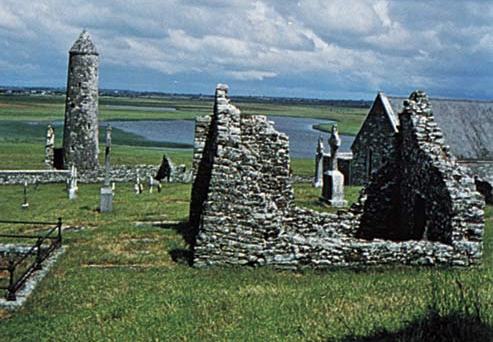
Sure, no one was wantonly slaughtered that Tuesday night, and few were wearing hairshirts, but the moment echoed a calamity played out countless times during the Dark Ages, as evidenced by the ruins at Clonmacnoise in County Offaly, Ireland.

Look at the catastrophic damage suffered by that small church at right, where, presumably, a longship full of crazed Vikings, hopped up on hallucinogenic mushrooms and seething in a blood frenzy, rowed right up onto land and crashed into it, after which the fearsome marauders swarmed the helpless settlement and drank all the beer without paying for it.

Of course, Monk's Café will be rebuilt—not fall into ruin like so many targets of Viking plunder. And, thankfully, its waitstaff were not carried off into slavery by the bus riders. But the damage to Monk's reminds us that, even a millennium after the Viking Age, we remain in dangerous times...times in which death and mayhem can strike at any moment and ruin a delicious imported ale, just as our monkish predecessors learned. So the next time I'm enjoying a pint at Monk's Café, or indeed anywhere, I'm going to savor every sip, because one never knows when some mode of public or barbarian transportation might come bursting through the walls and send me into Odin's arms for final judgment. Skål!

(Top photo of Monk's Café copyright The Philadelphia Inquirer; second photo copyright NBC 10 Philadelphia.)

Thursday, July 1, 2010

Too Bad There Aren't More Like Brind'Amour

Unless in reference to the likes of a world-shaking superstar, I would rarely comment on the retirement of a professional athlete—it happens too often. But Rod Brind'Amour deserves recognition for an outstanding 20-year career in which he proved himself one of the most dependable, valuable, and admirable players in NHL history.

A first-round draft pick of the St. Louis Blues, Brind'Amour learned well under head coach Brian Sutter, one of the hardest-working players ever to skate. Rod logged a first-team All-Rookie Team season in 1989-90, racking up 61 points and, even more impressively, a +23 rating.

A workaholic, Brind'Amour left a strong impression on me when the Philadelphia Flyers clashed with the Blues during his first two seasons, and I recall wishing that this hustling youngster wore the orange and black. General Manager Russ Farwell had the same wish and soon traded captain Ron Sutter and promising defenseman Murray Baron for Brind'Amour and Dan Quinn. The deal turned turned into a steal, even with Quinn lasting only 67 games in Philadelphia. Born to be a Flyer, Brind'Amour never took a lazy shift and quickly became a Spectrum favorite, even on a team in the midst of a ghastly five-year playoff drought. Not just an offensive-minded center, Brind'Amour, like Bobby Clarke, Bill Barber, and Brian Propp before him, was entrusted by his coaches with every situation. He worked the power play, killed penalties tirelessly, and developed into one of the best faceoff men of his time. 

Brind'Amour quickly became a star in the shadow of Eric Lindros and the Legion of Doom. Never as flashy as Lindros, John LeClair, Mikael Renberg, or Mark Recchi, Brind'Amour seldom received ink or screen time equal to Flyers with round numbers, but he was always there, scoring nearly a point per game for more than eight seasons—a franchise-record 484 of those games consecutively, thanks to his fanatical conditioning regimen. Brind'Amour never registered 100 points in a season, or even 40 goals, but no Flyer throughout the '90s was more reliable. In 1996-97—a subpar 59-point season for Brind'Amour (the only full season in which he would score fewer than 77 points for Philadelphia)—he made amends by erupting for a team-high 13 goals during the Flyers' run to the Stanley Cup finals.

But a pair of first-round exits over the next two seasons—even though Brind'Amour rebounded with consecutive 74-point seasons and led the team in playoff scoring both years—coupled with allegations of locker-room friction between he and Lindros fostered a deal with the Carolina Hurricanes for Keith Primeau. It was a controversial and risky trade—Brind'Amour the epitome of diligence, still in his prime, and beloved of Flyers faithful in exchange for the bigger and swifter, but perennially underachieving, Primeau, who had netted a measly 6 goals in 70 playoff games. In Philadelphia, Primeau had one good season, two strong playoff runs, and the epic five-overtime game-winner, but it was a trade that never should have been made. Brind'Amour was only halfway through his career, playing nine and a half seasons in North Carolina, becoming the Hurricanes' all-time leader in assists and points, helping them to the finals in 2002, and captaining Carolina to its first Cup victory in 2006. Along the way, Brind'Amour finally reaped the rewards of his devotion to complete play, earning back-to-back Selke Trophies. Arguably, he grew even more popular in Raleigh than Philadelphia.

Twenty seasons after first skating onto NHL ice, Rod Brind'Amour should stand in reach of Hall of Fame induction. Some may chortle, but his numbers and accomplishments outweigh Hall of Famers such as Cam Neely and leave in the corners others believed worthy, such as Guy Carbonneau. Only fifteen players have participated in more games in NHL history. Brind'Amour's 1184 points ranks 46th, ahead of several contemporary Hall of Famers, including Bernie Federko, Glenn Anderson, and Joe Mullen. His 44th-most assists puts him in similarly esteemed territory. And he's got one more Cup than five players elected to the Hall of Fame in the last decade combined.

In an era of high-priced prima donnas who whine about signed contracts, clamor for media attention, skip games because of hurt feelings, and have run-ins with the law, Rod Brind'Amour hustled his tail off, displayed exemplary character, and prospered without complaint.

Thanks for twenty great years, Rod.