Showing posts with label random thoughts/opinions. Show all posts

Friday, September 5, 2014

Over There...Over There...Why'd They Put All the Words Over There?

Today is the 100th anniversary of the start of the First Battle of the Marne, the week-long bloodbath that marked one of the first major clashes of World War I. Fought just east of Paris, this Allied victory prevented the Germans from reaching the French capital and making quick work of the war. Unfortunately, with more than half a million casualties laying dead or carried off the battlefield, the First Battle of the Marne also set the pattern for the devastating trench warfare that turned much of France and Belgium into killing floors over the next four years—a pattern of seesawing advances and retreats so futile that, nearly four years later, witnessed another major clash along the River Marne.

Known, of course, as the Second Battle of the Marne (above), this smaller, but still murderous battle halted the German advance in the summer of 1918 and hastened the Axis’ surrender. More than 132,000 Allied soldiers were killed or wounded in this three-week struggle, including 12,000 Americans.

County Route 537, which passes less than a mile from my home in its long trek across the breadth of New Jersey, is known within the limits of Mount Laurel, Hainesport, and Mount Holly as Marne Highway. Commemorating the great sacrifice of American doughboys in that second sanguineous battle, a blue historical marker is mounted on a Marne Highway road sign just west of the intersection with Larchmont Blvd. The problem is that the marker—a small-fonted, two-paragraph explanation of the Second Battle of the Marne—stands approximately 150 feet from the stop-lighted intersection. There is no shoulder in which to pull over (and if one did, one’s car would dangerously—and illegally—obstruct the right-turn-only lane that begins a few feet beyond the sign). Furthermore, there is no hope of gleaning more than a sentence of the marker even while decelerating toward a red light. (Imagine trying to read the sign above while moving at anywhere from 25 to 50 mph—hell, try reading it right now!)

Thus, the only possible practical way of actually reading this small acknowledgment of American contribution to that pivotal battle is to be stopped in traffic backed up from the intersection, which, although a line of traffic often does form there, hardly ever backs up that far.

Or one could simply walk over to the sign and stand just a few feet from the roadway to read it—a monumentally inconvenient and not-entirely-wise option, especially on that stretch of non-residential road flanked by daily-active railroad tracks. (This is exactly how I took this photo, walking home from the auto-repair shop a quarter-mile down the highway from this intersection.)

Sure, one could keep driving around the block, hoping to glean the entire message a line or two at a time with each drive-by—and this might just be most in the spirit of Great War stupidity, as driving around this block entails an approximate 2.2-mile trek, including three traffic lights, because none of the streets within this “block“ exit to another side of it. I guess a family could make a day of this by driving down Marne Highway, spying a line or two, turning right onto Larchmont Blvd., eventually merging onto Route 38 West, making another right onto Hartford Road, taking it back to Marne Highway, turning right, and again driving by the sign at approximate 7-minute intervals until the reading is complete (there is an Italian restaurant, Chinese takeout, and a 7-Eleven on the opposite side of the Marne Highway–Larchmont Blvd. intersection should a family wish to stop for lunch during their reading). I suppose a savvy couple or family could pre-plan for each member to simultaneously read a different section of the marker, which, if performed and recited correctly and in order, would drastically cut down on the time, effort, and gasoline expense involved. But this is not an easily executed strategy and could backfire catastrophically—like many a World War I offensive. 

Thus, to say that this historical marker was poorly planned and futilely placed is an understatement—also very much in keeping with World War I, itself, given the many atrocities perpetuated by idiotic generals who, time and again, ordered regiments of men “over the top” and into the waiting graveyards of no-man’s land.

So I‘m torn...

If the State of New Jersey (or perhaps Burlington County) allocated the expense and effort to commemorate the battle at all, then why not do it right and set the sign where it could actually serve its purpose instead of in a place where its words would surely go to waste? It seems certain that the genius employee of the state/county/township responsible for the placement of this historical marker was the great-grandchild of one of those World War I generals who so asininely sent their men off by the thousands to certain death for a few dozen muddy yards...

Did the war to end all wars teach us nothing about historical-marker placement? You can bet the Flemish sited their markers in readily accessible, easily readable locations.

And yet for all of its seeming idiocy, perhaps the Marne Highway historical marker is perfectly placed, ideally echoing the utter absurdity of the Great War, as if it were a modern-day, metal-plated Zimmerman Note.

Only Americans possess such a sense of irony...

Saturday, July 26, 2014

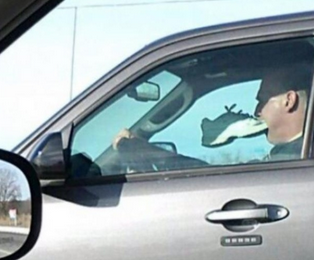
This Guy's Got a Little Too Much Nike on the Psyche

These photos have recently made the rounds on reddit.com. I know nothing of their source nor the reason for the driver’s unorthodox technique.

My guess is that he’s constantly saying embarrassingly asinine things.

Or perhaps he’s suffering from a particularly virulent case of Aphthae epizooticae.

If the former, we can only hope that this man is en route to sensitivity training; if the latter, that he’s on his way to a top-notch veterinarian.


Then again, I suppose this could be a pre-2005 photo of him placing a call on his mobile to Don Adams. (Laws prohibiting using a phone while driving were not widespread or well-enforced back then...)

Wednesday, July 2, 2014

Shame, Blame, and a New Name for the Washington Redskins

Washington Redskins owner Daniel Snyder continues to fend off pressure to abandon his franchise’s 81-year-old nickname. It’s a complicated and thorny issue, involving a long-dead racist owner, the First Amendment, shameful ethnic policies and attitudes, tradition, fan loyalty, and lots of money.

George Preston Marshall, who bought the fledgling Boston Braves in 1932 and changed its moniker to the Redskins, most likely was, according to Thomas G. Smith’s Showdown: JFK and the Integration of the Washington Redskins, the prime mover behind banning blacks from the NFL, a blight that commenced that same year. Whether he was or wasn’t, what cannot be disputed is the bewildering fact that Marshall’s franchise did not integrate until an ungodly-late 1962, essentially making him the NFL’s version of Tom Yawkey. And much like Yawkey’s long-vanilla Boston Red Sox, Marshall’s Redskins deservedly went a quarter-century between playoff appearances after World War II. (Interestingly, the Redskins of Boston played their four years in Fenway Park, making Marshall and Yawkey partners in slime, before Marshall relocated the franchise to the nation’s capital in 1937.)

There’s a lot more to Marshall’s sordid story, and although he always claimed the Redskins name was intended to honor America’s Indian culture, any man with Marshall’s track record on race relations is not to be believed.

Various attempts to make Redskins ownership change the franchise’s name have been initiated—some of them predating Daniel Snyder’s taking of the helm—but the fallback positions have always boiled down to either the extreme longevity of the name or a refusal to cave to political correctness. Advocates on opposing sides of the issue can cite polls that show ample support for either retaining or jettisoning the Redskins name.

From a legal standpoint, I don’t know what the answer is; from a moral standpoint, I’m in favor of changing any name that explicitly focuses on the color of one’s skin—especially in the capital of a nation that ostensibly stands for freedom and equality.

Of course, let’s not forget that this same capital did not deign to grant unconditional citizenship to American Indians until 1924...

Daniel Snyder is probably none of the things that George Marshall was, and his refusal to re-christen his franchise surely is not intended as a slap in the face to Native Americans. Yet he’s faced with an uphill battle to moral ground, and history won’t have his back.

My solution to this quandary is to rename the Washington Redskins the Washington Rosaceas. This, I strongly believe, would satisfy both sides—the offended party no longer endures a disparaging slur, while Washington ownership maintains the ethos of red skin while freeing itself of racist baggage.

And it keeps an “R” name, to boot.

If this then offends rosacea sufferers, well, there’s never been a solution that pleased everyone…


Tuesday, June 3, 2014

A Coupe Fit for a Pope—The Cordoba Could've Been a Holy Roller

What if the 1975 Chrysler Cordoba had seats made not from soft Corinthian leather, but from soft Corinthian letters—as in Paul’s letter to the Corinthians? Imagine driving in the plush comfort of parchmented scripture as you get to your destination in style and a state of grace...

I’m surprised Paul VI—the first pope to make formal appearances in a motor vehicle—failed to deem this his “Popemobile.” The 1975 Cordoba certainly was roomy enough to accommodate not only His Holiness, but a trio of his favorite cardinals as well. And with a three-speed, automatic, V8 engine, the Most Holy Father would rest assured that he’d get to his destination with all expedience. Paul VI could even have issued a papal bull re-designating his vehicle as a Chrystler Cordoba...perhaps also decreeing that something from First Corinthians become the brand motto...

Ricardo Montalbán: “The new 1975 Chrystler Cordoba—All things to all men (1 Corinthians 9:22).”

Saturday, May 24, 2014

Turning Siamese Would Have Been Quite the Coup d'Etat for All in the Family

Amid the current political upheaval in Thailand, capped by the military coup d’etat of May 22, this is the optimal time to examine why Chang and Eng Bunker, the original Siamese twins, would have made an even better Archie Bunker than Carroll O’Connor. Sure, O’Connor earned four Emmy Awards and a Golden Globe for his timeless and beloved portrayal of Archie Bunker, who, in turn, helped make All in the Family one of the most culturally significant programs in television history. America laughed for a decade at Archie’s convoluted logic, malapropos and mannerisms, his equal-opportunity bigotry, and his big-hearted narrow-mindedness—all of which mirrored a nation struggling with its own hypocrisy and neuroses by finding the right way to reflect all that was wrong with America.

Still, Chang and Eng Bunker, twin brothers conjoined at the chest by a large segment of cartilage, seem even better suited to the role. Born to Chinese parents in Siam (present-day Thailand), in 1811, the brothers found worldwide celebrity exhibiting themselves on tour as the “Siamese twins” (even rating a mention in the Guinness Book of World Records a century later as the source of the term). The Bunker twins later immigrated to antebellum North Carolina, becoming successful plantation owners—and slave owners, oddly enough, in view of the similarly low status of “Orientals” in that age—as well as naturalized U.S. citizens. Proving more desirable than many “single” men, they fathered twenty-one children between them—literally between them, considering the logistics involved—and died in 1874.

For a show called All in the Family, what could have been more familial than conjoined twins sharing the lead role? Especially with the ability to call Edith a dingbat and Mike a meathead in stereo? Perhaps even opting for the comedic drama of one brother a hard-line, war-hawk conservative and the other a bleeding-heart, pinko-commie liberal, verbally battling each other between orders to Stifle yourself! and moans of Aw, geez, huh? (Their inevitable problems with American enunciation hardly would have been worse than Archie’s butchering of the English language.) I don’t know if the Academy of Television Arts & Sciences would have awarded each brother his own Emmy, presented the two of them with a single prize, or, most likely, bestowed the twins with two individual statuettes soldered together, but Chang and Eng surely would have carted off during the series’ run an armful of them—carried with each lending one arm, of course.

During that narrow, 100-year window between Chang and Eng’s death and the mastering of special effects that now might allow twin Thai actors as talented and charismatic as Carroll O’Connor to appear conjoined—or, in lieu of expensive technical wizardry, at least have them share an XXXXXXXXXXXXL shirt—we certainly were fortunate that O’Connor gave the world Archie. But in a medium in which twins have long been prized both as a source of comedy and conflict, Change and Eng Bunker—the first of their kind, on the first show of its kind—would have yielded twice the laughs.

Boy, the way Yul Brynner played
Years on Broadway Mongkut stayed
Thais like us, double we weighed
Those were the days

And you knew Siamese twins
Didn't quite move like Errol Flynn
Messrs., we could use a man
Like Naresuan the Great again

Didn't need no coup d'etat
Everybody smiled through Buddha
Gee, Bangkok was Shangri-La
Those...were...the...dayssssss!

(Chang puts stogie to mouth with available hand as Eng leans head on Chang’s shoulder)

(Image of Archie Bunker copyright CBS.)

Wednesday, February 5, 2014

Sochi's a Little Roachy: The IOC's Black Sea Blunder

The 2014 Sochi Winter Olympic Games hasn’t yet begun—and already it’s an international fiasco bathed in the agony of defeat. Despite more than $50 billion spent in preparation for the world spotlight, myriad accounts of shockingly unprepared hotels and facilities are being tweeted out of the Russian city. But should we really be shocked by this? Russia—either under Soviet control or whatever grade of “free” government presently exists—has always possessed a toothpick-sculpture infrastructure overseen by cold, out-of-touch codgers who have never given a damn about their people’s quality of life.

Complaints and cries for help regarding no running water, stray dogs walking through hotels, hotel rooms not even finished construction, lack of heating, no Internet access, nonfunctioning elevators, and a multitude of other modern-age nightmares are racing out of Sochi.  

Stacy St. Clair tweeted the photo above of the horrifying state of tap water in her hotel. Guests were warned, “Do not use on your face because it contains something very dangerous.”

Whether it’s doorknobs that fall off upon touch, uncovered manholes, or, according to Greg Wyshynski, trash bins left in bathroom stalls with instructions posted to dispose of used toilet paper in them rather than flush it down the toilet, Russia clearly remains somewhere between a second- and third-world nation.

And all of this on top of the intended state discrimination against gay athletes...

Frankly, I wouldn’t be surprised in the least if the Russkies failed to manufacture enough medals and eventually will just give each medal-winner a bottle of vodka. Hell, I’m betting the Opening Ceremony will be delayed because Vladimir Putin is using the Olympic torch to restart the Kremlin’s pilot light...

It’s no understatement to say that the International Olympic Committee miscalculated gravely in granting Sochi the 2014 Games. The IOC would have done far better to select Xochitl (pronounced So-cheet), the fine Mexican restaurant on 2nd Street in Old City Philadelphia. Xochitl has an excellent cuisine and bar, commodes that can handle toilet paper, and even though looking into a glass of Philadelphia tap water might as well be peering into the eyepiece of a microscope, at least Xochitl’s doesn’t make you wonder if Howard Hughes has taken up residence in the kitchen…

And I don’t even want to think what culinary horrors with which those poor unfortunates are being tortured in Sochi—especially when they can be enjoying a succulent spicy brisket taco and a blood orange margarita by candlelight.

Okay, a restaurant self-described as “cozy” might be a little more cramped than a city of 350,000, but having patronized Xochitl on several occasions, I can tell you firsthand that its wait staff are likely far more cordial than, and their service far superior to, anything those unlucky guests currently are enduring in Russia’s largest resort town. In fact, considering all the negative press emanating from Russia over the last few days, Sochi isn’t so much a resort town as a last-resort town.

Once again, the world has erred by not first consulting me…

(Photo of Xochitl sign copyright Michael T. Regan.)

Monday, December 2, 2013

Not Winning the Oscar Must've Made Baldini a Grouch

It's well known that both Marlon Brando and Robert De Niro won the Academy Award for portraying Vito Corleone—the only instance of two actors winning an Oscar for the same role.

But what about Oreste Baldini, who played the nine-year-old Vito at the beginning of The Godfather II? I wonder if he’s bitter that he didn’t win an Oscar for his portrayal of Vito. Sure, Baldini was on-screen for only a few scenes...yet he showed fine range, shifting effortlessly from weak, dumb-witted native to weak, dumb-witted immigrant. And if that weren’t enough to convince Academy voters, Baldini was the only “Vito” to sing (while quarantined on Ellis Island)—something neither Brando nor De Niro dared do…or likely even possessed the acting chops to do.

My guess is that the now-51-year-old Baldini seethes in anger and jealousy every minute of his life since the evening Art Carney and De Niro walked off with the Best Actor and Best Supporting Actor honors, respectively, in April 1975. And although Baldini has enjoyed a busy career dubbing Hollywood dialogue into his native tongue for Italian cinema, television, animation, and even video games, it wouldn’t surprise me in the least if bilious ire occasionally flares into his on-screen translations.    

Had I been an Italian citizen taking in a film at the Nuovo Olimpia on the Via in Lucina in downtown Rome on a bygone Saturday evening, I would hardly be shocked if, right in the middle of Ed Wood, Johnny Depp ranted Art Carney può andare al diavalo, che non-talento hack!

Or even a purple-rhino'ed Edward Norton inexplicably yelling De Niro ha rubato la mia Oscar, che bastardi! Baldini ha la voce di un angelo! in the midst of singing ditties of support to methadone addicts in Death to Smoochy.

I might even have felt such sympathy for the slighted Baldini that I wouldn’t have demanded my money back from the theater manager… 

(Image from The Godfather II copyright Paramount Pictures.) 

Sunday, November 24, 2013

Kale-o, Newman! Could Newman Be the New Face of Kale?

I recently read that kale has anti-inflammatory properties. According to Carolyn Butler, writing in the Washington Post of September 25, 2012, kale—a leafy relative of broccoli, cabbage, and cauliflower—contains 45 different flavonoids that possess antioxidant and anti-inflammatory properties.

Quoting Deirdre Orceyre, a naturopathic physician at the Center for Integrative Medicine at George Washington University Medical Center, in that same article: kale has “a range of antioxidant and anti-inflammatory effects in the body.”

I immediately thought this would make for a great marketing opportunity for kale producers. Based on Newman’s “When you control the mail, you control... information!” rant in Episode 70 of Seinfeld, “The Lip Reader,” I urge the Kale Marketing Board, or whatever the hell exists that promotes the stuff, to hire Wayne Knight to reprise the scene in which he threatens Jerry with postal retribution for not letting him “borrow” his new lip-reading girlfriend. Nothing could better trumpet kale’s benefit to the human body than Newman reassuring the American public that “When you control the kale, you control…inflammation!” as he displays his not-so-inflamed hands.

Then again, as he did with kale’s unsavory cousin, broccoli, Newman would very likely take a bite and spit it out in disgust, exclaiming “Vile weed!” So maybe those kale folks should consider Frank Costanza as corporate spokesman—he probably doesn't find kale as distracting as tinsel... 


(Images from Seinfeld copyright NBC.)

Wednesday, November 6, 2013

Wedge Would Give This Eatery the Edge

Last night, I was treated to dinner at Butcher and Singer, the swanky Steven Starr steakhouse at 15th and Walnut. As you can see under the salad selections, this establishment offers “The Wedge”—a large slice of iceberg lettuce drenched in a bacon-and-Bleu-cheese Russian dressing.


Now, maybe my proclivity for free-associative thinking was abetted by dining in a Steven Starr restaurant, but, upon first sight of it, I immediately conjured the idea of Wedge, the Rebel Alliance pilot who flew alongside Luke Skywalker in Star Wars and played a key role in all three films of the first trilogy, emerging from the kitchen in full pilot uniform and serving me The Wedge while regaling me with priceless anecdotes from the set and personal war stories from the Star Wars universe.


After all, the actor who portrayed Wedge, Denis Lawson, also played the ubiquitous Gordon Urquhart, the hotelier, chartered accountant, and community negotiator who also waited tables in his MacAskill Arms dining room, in one of my very favorite films, Local Hero. Expert in both roles, it would be no stretch to have the aproned innkeeper who served meals to his guests do so for me while dressed instead as the orange-jumpsuited fighter ace who helped send both Death Stars to their doom.       

And as Wedge placed The Wedge in front of me, I think it would go a little something…like this:

“Look at the size of that thing!” I marvel at the large, ludicrously priced wedge of lettuce. Appreciating my homage to his most famous line of dialogue, Wedge then pours me a 42-year-old scotch like the one Urquhart serves up in Local Hero.

“Slàinte,” he toasts me.

“Good shooting, Wedge,” I commend his expert pouring ability before taking a swig.

“I can’t stay with you,” Wedge confesses, needing to return to the kitchen.

“Get back there, Wedge. You can’t do anymore good out here,” I urge gratefully.

“Sorry,” Wedge laments in his Corellia-by-way-of-Furness accent, peeling off toward the kitchen. And as I dig into my ridiculously, just insanely overpriced chunk of iceberg lettuce with a little dressing drizzled on it, I am wholly satisfied with the wait service from the best damn pilot the Alliance ever had. 

(Image of Butcher and Singer menu copyright Steven Starr Restaurants; image from Star Wars copyright Lucasfilm; image from Local Hero copyright Warner Brothers.)

Monday, October 14, 2013

Papillon's Story Is Finally Complete and Finished

Whenever the South American nation of Guiana is mentioned, most, if not all of us, think of the Steve McQueen–Dustin Hoffman film, Papillon. After all, this classic prison tale—set in the penal colony of French Guiana and its offshore solitary-confinement counterpart, Devil’s Island—put Guiana on the populace’s proverbial map.

So it should be no surprise that when I received an e-mail today mentioning a Guyanese man in a mildly amusing anecdote, I reflexively thought of this great film. Now, the e-mail is almost certainly a fabrication—I could find no verification of it on the Internet. Still, I couldn’t help but think that this anecdote should have constituted the narration at the end of Papillon, rather than the brief explanation of the infamous French prisoner’s ultimate fate and the destiny of the penal colony.*
* Although I believe that this colorful anecdote should have been spoken—like the film’s actual postscript—rather than shown, I have included it below as text because I can't afford to pay the original narrator to call each one of you and speak it.

Frankly, I’m surprised some innocuous yarn wasn’t used as the film’s postscript, considering how ardently Hollywood demands a happy ending. After all, what could provide a happier ending than a slightly charming, somewhat-clichéd slice of life about the trials of domesticity to which many of us not incarcerated in a pestilential jungle hellhole can relate?†
† Sure, Papillon “made it to freedom,” but he made it several months after the end of World War II—too late to do his duty for France by surrendering to the Germans…certainly a sadder ending to the film than the brief, wry smile provided by this anecdote.
I fully expect the contents of this e-mail to replace the film’s original postscript when Papillon is inevitably re-released in 2023 for its golden anniversary.


(Images fromPapillon copyright Allied Artists.)

Monday, September 30, 2013

Good at Blocks...But Still a Blockhead?

I’m good—I mean really good—at Tetris, that falling-puzzle-piece game that challenges quick-thinking spatial reasoning and hand-eye coordination. I routinely can make high-level games last for twenty minutes or longer, racking up 200 to 300 lines before “topping out.”

In fact, on September 26, I established a personal record of 541 lines, utilizing lightning-fast mental processing and dexterity that I somehow maintained for more than half an hour through numerous ultra-close calls. Yesterday, I nearly bettered it with a game of 538 lines.

But, as just happened a few minutes ago, I always encounter inexplicable difficulty in properly placing shoes in a shoe box—I keep turning the second shoe around and over and backward until it fits into the shoe box in proper opposition to the first shoe. Despite my proficiency at Tetris, this most basic of spatial challenges often takes me up to half a minute to solve. And after finally placing the shoes properly into the box, I’m forced to realize that even though I’m very talented at a video game, I’m a borderline failure at putting this ability to practical use.

Like Tetris, I used to be an ace at that old, submarine-periscope arcade game, Sea Wolf. But perhaps the hard truth is that, under combat conditions, I don’t possess the right stuff to sink an enemy warship. All those quarters wasted thinking I’d be a cinch to win the Navy Cross if I enlisted when I came of age. No wonder Somali pirates roam the Indian Ocean at will—I would’ve washed out of Navy Officer Candidate School and probably spent my hitch in the brig. No wonder my dress shoes forever lay around on closet floors—I’m too intimidated by my mental incapacity to put them back in their box.

Maybe I’m just a complete moron who happens to be an idiot savant at Tetris.

Yeah, yeah, two seconds to green z-shape, yeah…


Sunday, September 1, 2013

In 1939, Poland Had the Worst Seat in the House; in 2013...

On this, the 74th anniversary of the start of World War II, it seems fitting to post this photo, which has been making the rounds on the Internet this year.

Especially on this day, the poor guy squeezed between these two behemoths is all too reminiscent of Poland trapped between Germany, on his left, and the Soviet Union, on his right. Like Poland, he is powerless to defend himself and will be crushed long before the game is over.

Soon after Germany's blitzkrieg, which commenced on September 1, 1939, the Soviet Union, having previously signed a non-aggression pact with Germany, invaded from the east...effectively obliterating Poland as a sovereign nation.

Both England and France, having pledged to defend Poland at all costs, then declared war on Germany. Yet, like the two spectators sitting disinterestedly in the front row, they did virtually nothing to aid their besieged and very uncomfortable ally.

(The people in the row to the rear ably represent Holland [as evidenced by the man's orange shirt] and the other Low Countries, all of which were soon to feel the murderous weight of Germany when the woman on the left leaned back in her seat.)

And speaking of France and her role in the Second World War, no photo could be more appropriate than this one...

Saturday, August 31, 2013

Hell in the Atlantic

Tonight, I was watching a DVD of one of my favorites: the World War II, marooned-on-an-island classic, Hell in the Pacific. More than half of the opening thirty minutes of the film focuses on Lee Marvin trying to get at Toshirō Mifune’s small supply of fresh water, either by stealing it or asking for some. Just as this angle comes to a climax—with Marvin falling from a tree while attempting to fish out some water with his canteen, crashing into Mifune, and spilling the precious basin of collected rainwater—I realize that the bottle of Poland Spring from which I am now taking the last sip is my sole remaining bottle—and thus my only remaining drinkable water!  

Sure, I could have opted for tap water, but not since having seen all sorts of things in the tap water from my college dorm in Philadelphia have I trusted water from the faucet and would have spat it out as undrinkable—as did a repulsed Marvin after dipping his face in a stagnant, salty pond before continuing his pursuit of Mifune’s fresh rainwater.
So, as with Lee Marvin and his Imperial Japanese Navy rival, my survival came down to cooperating with my Mitsubishi Eclipse to obtain fresh water—the very same Mitsubishi that produced the A6M “Zero” fighter for Mifune’s Imperial Japanese Navy!

Would my car take me where I needed to go, or would it make me its captive, as did Mifune of Marvin, before Marvin escaped and turned the tables on his opponent? Could I harness the Mitsubishi’s power and make peace with it, so that we could work in tandem for our mutual benefit and set off promptly to 7-Eleven for its rich supply of Poland Spring?

Alas, upon arrival at 7-Eleven, the Mitsubishi most likely would have abruptly exploded with no warning, destroying both of us.*

Or perhaps, in some alternate ending to my evening, my Mitsubishi would refuse to open its doors, and after yelling and honking at each other in foreign-tongued futility, we’d go our separate ways as enemies once again.

* Okay, so I should have prefaced this with a Spoiler Alert…but let’s face it: you’re never gonna get off your ass and rent this film—or come to my place and watch it with me. No, it’ll be just another Saturday night alone, marooned in my apartment, waiting for the tides to be right so I can get off this desolate rock...I mean couch. Man, I would’ve been much better off had my Mitsubishi exploded...
(Images copyright Selmur Pictures.)

Monday, August 12, 2013

Yo-Ho-Ho and a Bottle of Ron!


Ron Jeremy is, quite possibly, the most famous male porn star in the history of that fine genre of art and will undeniably become a charter member of the Jewish Pornographic Hall of Fame, whenever such a long-overdue institution is conceived and green-lighted.

In fact, with Jeremy’s fame spread wider than all of the legs between which he’s plied his trade set side by side, perhaps it should come as no shock that I recently saw this offering in my local liquor store.
Now, apart from my concern that rum is only one frightening typo away from upon what Ron Jeremy has built his messy career, I’m likewise alarmed at the thought of—as mezcal has the “worm” at the bottom of the bottle to add a touch of flavor and exoticism—what might the manufacturer put in Ron De Jeremy Spiced Rum…the foreskin?  


Wednesday, August 31, 2011

Finding a Founding Father Lacking in Accuracy

So you know those Citizens Bank ads featuring Alexander Hamilton. Most people don't have any idea of Hamilton's role in the founding of our federal banking system. In fact, a large part of our oblivious populace is not aware that it's Hamilton gracing the $10 bill (I've met some of this lamentable demographic personally).

But what's the one thing practically every school child is taught about Alexander Hamilton? That he was killed in a duel by Aaron Burr, the Vice President of the United States.

So why doesn't the actor in the Citizens Bank commercials have a big, bloody bullet hole in his lower abdomen? I mean, can't we have some concession to historicity?

It doesn't even have to be overt. Perhaps Hamilton, in touting the virtues of Citizens Bank, explains to his Federalist colleagues, "Some people get shot...a good bank gets that," as Hamilton rolls his eyes downward and motions his brow toward his damaged torso, before collapsing in agony from his mortal wound...then cue the fife-and-drum jingle as his colleagues clumsily administer a poultice and brandy in vain.

Otherwise, Alexander Hamilton is just another Founding Father, as anonymous as Nicholas Gilman or Gunning Bedford, Jr.

Friday, August 12, 2011

Hate Baiting in Fishtown

Forget the Hulk—this is one angry banner...

The building upon which this vitriolic banner flies (this photo has not been doctored in any way) is located on the 1100 block of Earl Street, in Philadelphia's Fishtown section. The Bank of America to which this certainly refers is located around the corner, on Girard Avenue.

Now, I'm just wondering what Bank of America could have done to elicit such hatred that someone went to the time-consuming, costly, and probably perilous trouble of making this banner and affixing it to his or her home (notice there are no windows from which to easily hang it).

Did Bank of America turn down this resident's loan application for a start-up banner company? Has Bank of America slashed its business hours to 9:00–9:10 AM, Mondays only? Are Bank of America's tellers laughing at this customer's balance every time (s)he comes in to make a transaction?

Banks can be very intimidating entities with which to deal. A bank most likely has more money than you, which can make you feel inferior and disadvantaged. So this could merely be a case of fiscal jealousy; however, such rage would be misplaced, because the guitar shop, the burger place, and the realty office a few doors down from the Girard Ave. Bank of America surely also have more money than this resident—so (s)he may well just be venting at the most readily recognizable symbol of financial superiority.

But even in these economically frustrating times, in which tempers toward the well-to-do are boiling over with increasing regularity, such ire as drapes this building must certainly result from a particular action.

So I'm betting that Bank of America slept with this resident's wife...

Thursday, May 5, 2011

Interstate Love Sign

At the entrance ramp of Exit 1D on I-76 West in Gloucester City, New Jersey, stands one of those oft-seen, blue “Sponsor a Highway” signs. (There are actually two types of these signs: the “Sponsor a Highway Program,” in which the Adopt A Highway Maintenance Corporation performs the actual litter removal, and the “Adopt A Highway Program,” in which the interested party leasing the sign “adopts” its mile of road and physically maintains it, in much the same way as did Cosmo Kramer—although widening the lanes is frowned upon). These signs are rented by local establishments such as Cracker Barrel or institutional corporations such as Blue Cross for high-profile advertising in heavily trafficked areas. However, the particular sign of which I speak was leased to Club Risqué, a gentlemen’s club in nearby Philadelphia.

I don’t have a problem with this. I've frequented Club Risqué on a number of occasions and found it to be a pleasant and enriching experience. With what I do have a problem is that Club Risqué opted for the “Sponsor a Highway” program rather than “adopting” its mile. When I’m stuck bumper-to-bumper on an interstate and feeling angry and frustrated, what could better ease tension than watching the Club Risqué dancers cleaning up their mile of median and roadside? Club Risqué’s mile also contains numerous light poles upon which its employees could be performing their mesmerizing art. Instead, the frankly unattractive and hirsute Adopt A Highway Maintenance Corporation is out doing the job.

Club Risqué missed a great opportunity both for product demonstration and for helping out beleaguered commuters. As a motorist, I find this distressing.

Tuesday, January 4, 2011

You Can Take That to the Bank...But You’re Better Off Using Your Mattress

TD Bank’s registered logo is “America's Most Convenient Bank.” You’ve surely seen one of its numerous television ads featuring Regis Philbin and Kelly Ripa. But I’ve been banking with TD Bank since it took over Commerce Bank, and I contend that TD Bank is perhaps America’s Least Convenient bank. For instance:

On Monday, I queued up in one of my local branch's four drive-thru lanes to deposit a check. After stuffing the check and deposit slip into the container and sending it to the teller, I sat and waited for more than ten minutes as five customers who had entered their lane and began their transaction after me received service and drove away while I continued to wait.

Inconvenient.

The very next day, I drove to the same branch to obtain some temporary checks because I was still awaiting the arrival of my new ones. The customer-service representative informed me that they did not have any temporary checks and that I would have to go to another branch to get them.

Inconvenient!

These are inconveniences occurring just this week. There’s also the $4.00 “maintenance fee” that TD Bank charged when my savings-account balance fell below $250.00. I didn’t even know this fee existed...and they charged me for it four consecutive months. I accrued 75 measly cents in interest on my savings in 2010...yet TD Bank took $16 for “maintaining” my account! What did that maintenance require? Leaning over to shift cheeks while sitting on their fat asses staring at the sun and waiting for 5:00 so they could run to Prospector’s and down a martini with my money? Okay, so I have Web access to my account, which could have alerted me earlier to this hidden fee—but I rarely used my savings account in 2010 and seldom had need to check it. Bottom line:

In...con...ven...ient.

And if I had a nickel for every time a TD Bank ATM was out of service when I needed to use it, I’d have just enough money to open another TD Bank savings account and lose $4 a month in maintenance fees...

Quite inconvenient.

Further making its customers’ lives more difficult, TD Bank used to allot to account holders two money orders a year without charge. A TD Bank money order now costs an account holder $4.

Extremely inconvenient!

TD Bank’s advertising campaign further boasts about its “legendary service” (as seen in small print in the ad above). I would very much like Regis and/or Kelly to explain what’s so "legendary” about it. Banking, in one form or another, has existed since antiquity. Certainly, the banking families of Renaissance Italy introduced practices that are still in use today, and Alexander Hamilton proved to be one of the greatest banking minds in modern history, organizing the first bank of our fledgling nation. But TD Bank as an operating unit dates back only to October 2008—hardly a history with which to achieve “legendary” service. Now, had TD Bank lent substantial sums to Charles V so he could finance his wars against the Valois kings of France, or perhaps had it provided coin-counting machines and safety-deposit boxes to the Pilgrims, then a claim of “legendary service” might be justified. But TD Bank reviving the tradition of offering free lollipops at its counter doesn’t cut it. Finance a crusade or two... Provide home-equity loans in gold ducats... Offer a 700-year CD so you’ll have a viable past by the time it matures... At least give out free quill & inkwells instead of those cheap pens... Something to legitimize your claim...

Most convenient?

Perhaps TD Bank should drop Regis and Kelly in favor of the Church Lady so as to make more obvious that its claim is a goof.

Besides, Dana Carvey needs the work...


Postscript

The checks I ordered more than three weeks ago still have not arrived.

Ludicrously inconvenient!

Post-postscript

As of October 2012, TD Bank no longer sells postage stamps through its ATMs.

OFF-THE-SCALE INCONVENIENT!

Post-post-postscript

May 31, 2014: Once again, the ATM is out of order, necessitating that I stand in a long line for counter service while staring at the AMERICA'S MOST CONVENIENT BANK slogan—the banking world's version of the Warren Report—all-too-proudly mounted on the wall behind the tellers.

INCONVENIENCE INCARNATE!

Post-post-post-postscript

July 30, 2014: Again, the ATM is out of order. Standing next in line, one teller occupied and the other teller busy doing apparently nothing, a customer-service employee, seeing me growing visibly frustrated, walks across the bank floor, goes behind the counter, and asks the unoccupied teller whether he informed me that his line is closed. The teller responds affirmatively despite never having even looked up to see me standing at the head of the line about ten feet away, let alone never uttering a single word to me. A brazen and shameless lie that would have Alexander Hamilton spinning in his urn—made without even attempting to conceal his fallacious claim from my ears.

INCONVENIENCE-TURNED-IMPUDENT DISHONESTY!

Post-post-post-post-postscript

October 14, 2014: The TD Bank in Lake Worth, Florida, has a line of customers almost out the door, yet only a single teller is working the counter. Making matters worse, at least for me, of the fifteen (15!) slots of transaction slips available at the front-door counter, exactly none (0!) of them contain withdrawal slips. Apparently, TD Bank doesn’t want you to have access to your money.

TEETH-GNASHINGLY INCONVENIENT!

Post-post-post-post-post-postscript

December 26, 2014: As the fifth car in the drive-thru this afternoon, more than ten minutes passed without a single transaction being completed by the unconcerned teller, who instead found it more important to wave at, and inquire about, the crying infant in the lead vehicle. Finally, I pulled out of line, parked, and conducted my banking inside.

When the drive-thru is slower than going inside, it’s time to look for another bank...

Post-post-post-post-post-post-postscript

October 5, 2015: Brought $174.15 of coins to TD Bank to deposit in their coin counter. (I painstakingly hand-counted every coin last evening, logging each one with a tick mark, by denomination, on a white-lined sheet of paper, because more than a few reports exist of banks deliberately miscalibrating their machines so that they can shortchange you and bilk you out of even more of your money.) Sure enough, the TD Bank machine produced a total of $167.41—more than $6 short, putting this far beyond the realm of an innocent margin of error. The bank manager didn’t count on me producing the hand-logged inventory of coins and, after ten minutes of awkward fumfering on her part, my account was finally credited the full amount. However, I still did not receive the $1.99 bonus for guessing within $2.00 of the pre-count total (I input the exact amount, of course).

KISS MY ASS, REGIS AND KELLI!

Post-post-post-post-post-post-post-postscript

November 28, 2015: More than two weeks after closing out my safety-deposit box (going into my local branch, removing my property, and signing the forms to officially terminate the account), I received a late notice for safety-deposit box renewal. TD Bank is demanding $43.00 in 2016 fees for a deposit box I no longer rent. To add insult to buffoonery, TD Bank is still sending my mail to my old address, which I updated in its system more than a month ago.

PUCKER UP AGAIN, REGIS AND KELLI!

Post-etc-script

January 13, 2016: My debit card—which is “good thru” April 2016, has virtually no wear on it, and has never before given me a problem either at an ATM or accessing one in a locked TD Bank lobby—failed to unlock the door of my local branch tonight, I had to sit in the dark parking lot until another customer entered the lobby, so I could stand outside and wait until he exited. If you think that was vexing enough—and it was—understand that the $1.5 billion Powerball drawing is tonight—and with ticket sales ending, by local law, at 10:00, I was fighting the clock to get cash. Sure, I could have gone to a non-TD Bank ATM, but the galling surcharges tacked on by both the host bank and good ol’ TD would have amounted to anywhere from $6 to $8. After paying nearly half a billion dollars in federal, state, and local taxes on my Powerball jackpot winnings, there’d hardly been anything left thanks to TD’s grubby little hands...

I’D LIKE TO KICK YOU IN THE POWERBALL, TD BANK!

Super-post-etc-script

November 12, 2020: I just discovered that TD Bank has hiked its annual fee for a safety-deposit box from $45 to $70—a 64% increase!

FLAT-OUT HIGHWAY ROBBERY, TD BANK!

Double-super-post-etc-script

August 22, 2022: Faced with the potential of being stuck behind a long line of cars at TD Bank’s drive-thru during the lunch hour, I pulled myself out of bed early for its opening at 8:30 am. Arriving at that time, I was second in line and figured to have an expeditious deposit of my check. Once again, TD Bank proved itself anything but America’s most convenient bank. The customer ahead of me took nearly ten minutes to complete his transaction. I’m not entirely sure who was responsible for this absurd manipulation of valuable time as the clock ticked toward the start of the workday and my need to be home to log on in a timely manner. I could not make out the majority of the words as the teller spoke to the customer, but it seemed as if the customer had erred or miscalculated in some way, for the teller returned paperwork to the customer via the extending tray. More minutes went by, and my entirely justified and expletive-laden complaining rose to a level that, but for the car radio, might have been detected by both parties ahead of me as it seeped out of my half-open window. Some putz apparently trying to refinance his mortgage in the drive-thru lane is the height of arrogance and a real screw you to fellow customers.

YOU’RE A NIGHTMARE NO MATTER WHAT TIME OF DAY IT IS, TD BANK!

(TD Bank ad copyright TD Bank; Church Lady photo copyright NBC.)

Tuesday, October 5, 2010

When the Cosmo Aligns...Giddy-up!

Like many of you, I harbor deep regrets: Ruined romantic opportunities. Misguided career decisions. Short-sighted moments of inaction. Some of these have steered the course of my life for the worse, or at least left lasting scars that I’ll carry for the rest of my days.

If I were to compile a list of my regrets, one that remains fresh bears getting off my chest:

Spring 2004: I’m walking north on 19th Street, about a block and a half from my then-residence just off Rittenhouse Square. Roaring toward me comes a hook & ladder, siren blaring as it responds to a call on the other side of the square. I saw the fire engine coming, and my immediate instinct was perfectly natural for a Seinfeld connoisseur: yell "Hey, Kramer!" to the hook & ladder's rear driver, just as in Episode 117, "The Secret Code." Maybe he'd respond as did Kramer—with a wave and a yell. Maybe not. Either way, I'd be fulfilling every Seinfeld fan's dream: to play out in reality a classic moment from the show. I had several seconds to react, but a completely irrational inhibition of drawing attention to myself on a public street cropped up and, unbelievably, kept me from seizing the Kramerian moment...as the opportunity tragically passed forever. I think about that moment a lot—perhaps not as much as foolishly opting to transfer out of what was a pretty good party school after my freshman year or failing to take Miss So-and-So to bed—but enough that the pain flares every time I see that Seinfeld episode in reruns or hear a fire engine's horn racing down the block.

Other regrets:

• Never went to a Gordon Lightfoot concert on acid
• Spent three years earning a PhD in Morse code on a hunch that e-mail was a passing fad and the telegraph would make a comeback
• Chose to see Avatar in 1-D
• Have never visited 332 Kellett St., Deloraine, Manitoba
• Got out of bed most days
• Approaching my 43rd birthday, yet still don't know what the difference is—if any—between a sweet potato and a yam
• Convicted of a Class B misdemeanor for castling in a checkers game
• Took a stunning 19-year-old, 5-foot-six, 110-pound, 38-DD, redheaded vegan to an all-you-can-eat rib joint on a first date because I was in the mood for ribs


(Images copyright NBC.)