Showing posts with label television. Show all posts

Wednesday, October 22, 2014

! Spy Too Many Exclamation Points on !-95

While driving home from Florida, I passed this sign yesterday, which stands at Exit 169 on the southbound side of I-95 near Florence, South Carolina. It looks to me like writer Jake Jarmel now manages the Triple T Truck Center and he hired on-again-off-again girlfriend, Elaine Benes, to edit his billboard.

Of course, Elaine, upset that Jake’s latest endeavor lacked a certain emotion and intensity, apparently added unnecessary exclamation points—ostensibly to connote such messages as:

“It was a damp and chilly afternoon, so I decided to drive my semi!”

and

“I pulled the lever on the clutch, but the truck’s engine wouldn’t start!”


Okay, the dialogue implies a plot so banal that an inordinate number of exclamation points may be the only thing keeping this truck-repair place from being boarded up in bankruptcy, but Mr. Lippman isn’t going to see it that way and will want those exclamation points gotten rid of, should he drive by…


(Images from Seinfeld copyright NBC.)

Sunday, September 28, 2014

Maybe the "T.S." Stood for "Terribly Similar"...

Jesse Lee Tally, known as “Doc” Tally, played baseball for the barnstorming Israelite House of David team from 1914 to his death in 1950. The House of David was a religious commune founded in Benton Harbor, Michigan, in 1903 and thrived through the 1920s and 30s. Its founders—not the most visionary of religious leaders—declared sex a sin (even for procreation), in principle dooming their movement after a single generation.

The House of David became a national phenomenon during that time for fielding a long-haired, long-bearded evangelizing baseball team (actually, several teams) that crisscrossed the country playing amateur; semipro; and professional opponents, including squads from the major, minor, and Negro Leagues. Sort of the Harlem Globetrotters of baseball, the House of David team grew famous for its fancy, yet very formidable, play. It even, for a time, boasted several former Major League greats, including Three Finger Brown and Grover Cleveland Alexander, as well as the legendary Negro Leaguer, Satchel Paige—all of whom were required either to grow their whiskers or don a fake beard.

The House of David even beat the Major Leagues to night baseball, playing its first game under electric light in 1930—five years before the Bigs. (Ever shrewd in enlarging opportunities to play for paying customers, the House of David brought portable lights on its buses to allow night games.)

Anyway, I find Jesse Lee Tally the spitting image of the recently deceased Robin Williams. Reputedly the House of David’s best player, Tally invented the famous pepper games with which players would wow crowds with their acrobatic and dexterous skills before, and during, contests. Tally thus seems like the same type of good-natured, entertaining ham that Robin Williams came to be. Interestingly, Williams, a Chicago native, was born little more than a year after Tally’s death and just a hundred miles from Benton Harbor.*

* Perhaps stranger still, Williams starred in the resemblant-named 2004 “dramedy,” House of D.

It’s almost as if Jesse Lee Tally’s spirit entered the newborn Robin Williams’ body in 1951—all it had to do was float to the far side of Lake Michigan, and it had more than a year to do so…


So, it is entirely possible that Robin Williams possessed great baseball potential, even if he never sensed it. However, the world is a better place for him taking the route that he did—not only because he left a legacy of laughter, but because Williams’ natural inclination to field a batted ball, then toss it in the air while declaring, “Fly, be free!” would have led to a catastrophic amount of unearned runs…      

(Image from Good Will Hunting copyright Miramax Films; image from Mork and Mindy copyright ABC.)

Saturday, August 9, 2014

If Only Clubber Lang Had Taken on Pyongyang...

Im watching a M*A*S*H episode from 1981. Thankfully, MeTV runs restored versions of M*A*S*H that include scenes, or parts of scenes, long ago hacked out by greedier broadcasters squeezing episodes for every last second of commercials. Some of these scenes likely have not been shown for decades—I certainly dont recall a lot of them despite being a M*A*S*H aficionado since the mid-70s. 

Tonight, it was Episode 223, “Give ‘Em Hell, Hawkeye,” in which Capt. Pierce, fed up with year-long peace talks that have achieved nothing, pens a letter to President Truman, narrating it in voice-over as he writes. And as Hawkeye writes his letter, he refers to Harry—in newly restored dialogue—as “Mr. T.”

Now, the actual Mr. T, Laurence Tureaud, took that name in the late 1970s, but he was, by and large, anonymous until appearing as “Clubber Lang” in Rocky III, which debuted over Memorial Day weekend in 1982.

So, clearly, Hawkeye using the name “Mr. T” in an episode filmed nearly a year earlier is unrelated to the yet-to-be celebrity of Mr. T.*

But I can’t help wondering: if Mr. T had only become a Hollywood name a matter of months earlier, he could have actually portrayed President Truman in that M*A*S*H episode (M*A*S*H already had a long history of employing young, ascendant actors in guest roles). I see the episode as a two-parter, in which President Truman, “Mr. T,” responds to Hawkeye with a letter of his own—and, as did Hawkeye, narrating his reply in voice-over as he authors it...perhaps over a montage of his training regimen in the Oval Office, such as jumping rope, using a speed bag, or whatever else passed for hardcore cardio training in the early 1950s. 

Dear Capt. Pierce,
Thank you for your letter pleading for me to end this police action. However, you don’t seem to understand politics. One doesn’t back down from international threats to peace. South Korea was attacked. Attacked! You get it? If that little man, Kim Il-sung, don’t wanna come to the peace table, then I’ll come to him. The United States is ranked No. 1. ONE! That means we’re the best. But that bum has been taking the easy matches, sneak-attacking its peaceful neighbor. I’m telling you and everybody else at the 4077th: the United States will fight North Korea anywhere, anytime, for nothing. No, I don’t hate Kim Il-sung…but I pity the fool, and we will destroy any man who tries to take what we got.  

In closing, my prediction for the war: pain. 

Yours sincerely, 
President T

With aggressiveness that would’ve made Gen. Douglas MacArthur look like a Salvation Army bell ringer and accountability that would’ve left Harry S. Truman resembling a shriveling buck-passer, Mr. T might well have provided a ratings spike and seriocomic possibilities encouraging the stable of M*A*S*H writers to continue for several more seasons—perhaps even long enough to necessitate a romance between Hot Lips Houlihan and SSgt. Rizzo that would have perfectly encapsulated the lunacy of war...not to mention paved the way for either the best or the worst spin-off in television history.

*Far predating this M*A*S*H episode, a Welcome Back, Kotter spin-off called Mr. T and Tina briefly ran on ABC in 1976, but the show was so short-lived and obscure that not even its star, Pat Morita, remembered it. Perhaps if he’d come up with the “Crane” a decade earlier…

(Image from M*A*S*H copyright CBS.)

Sunday, August 3, 2014

We All Lifted a Yellow Submarine...

So, I just turned on the TV and caught the last ten minutes of The Three Stooges in Orbit (1962), a film I hadn’t seen since I was a kid. And in that brief span, several elements immediately jumped out as closely presaging subsequent films—to the point that I wondered more than just fancifully if this predictably insipid film filled with recycled jokes and made on the cheap for a very over-the-hill comedy troupe could actually have been the source of certain concepts used in later, higher-profile works.

Look at the propeller-powered flying submarine stolen by the Martians (above). Is this not practically a real-life, full-scale model of the Beatles’ yellow submarine depicted in the 1968 animated feature film? The Three Stooges in Orbit predated Yellow Submarine by six years—yet looking at the similarities in concept and design, it’s not hard to suppose that the director of the Beatles’ film, George Dunning, was a Three Stooges fan who caught their movie upon its theatrical release,* perhaps even screening it privately six years later for the crew of animators to give them a definitive sense of the artistic style he wanted.

* In 1962, Beatlemania hadn’t yet swept England, so Dunning, a Canadian expatriate who had yet to become associated with the Beatles, likely was walking around London with little to do and thus had plenty of free time to see the new Three Stooges film.

Moments later in the film, Professor Danforth, played by long-time quasi-Stooge, Emil Sitka, displays an animated television segment of the Stooges dancing to stock, early 60s pop music. This is perhaps even stronger proof that George Dunning and his crew lifted ideas from this Three Stooges film. As you can see, that’s impressively sophisticated animation for 1962—and it appears very much the progenitor to the dazzling animation of Yellow Submarine. Granted, the Stooges weren’t as limber as the girl dancing to “Lucy in the Sky With Diamonds,” but their particular brand of fat, elderly elegance must have made a lasting impression on Dunning.

Okay, this weakest incarnation of the Three Stooges is no “Fab Four,” but consider the cumulative work of Moe, Larry, Curly, and the criminally underrated Shemp—that’s a four as fab as John, Paul, George, and Ringo, for sure.†

† Continuing the numbers game, the Three Stooges and the Beatles each counted six participating members among their ranks: the aforementioned four in each group, plus, of course, latter-day Stooges Joe Besser and Curly Joe DeRita as well as Beatles’ castoffs Stuart Sutcliffe and Pete Best.

Furthermore, the Three Stooges went into widespread television syndication in 1958, introducing them to a new generation—the Beatles’ generation. With the future Beatles all in their highly impressionable teens at that time, it’s a good bet the lads watched and enjoyed the Stooges’ tomfoolery—especially the angry, young man of the fledgling group, John Lennon, who probably would have appreciated them most. I can easily see the Stooges’ violent tendencies having rubbed off on the volatile Lennon. (The Three Stooges was actually removed from syndication for a time in the 1960s when mothers complained that their children were emulating the Stooges’ dangerous antics.) Now, I’m not saying that a few episodes of Moe bullying Larry, Curly, and Shemp led to Lennon kicking original bassist, Stuart Sutcliffe, in the head—as has occasionally been alleged in the cause of Sutcliffe’s untimely death—but I am saying that an irate John likely was not above rapidly fluttering his hand in front of Sutcliffe’s entranced gaze, then snapping it down briskly, causing Sutcliffe’s head to do the same. Whether that facilitated Sutcliffe’s fatal cerebral hemorrhage, no one will ever know—but it sure looks like a lot of stress on the brain…

As an aside, yes, the Beatles’ animated TV series (which the Fabs had nothing to do with production-wise) debuted a month before The New Three Stooges cartoon in autumn 1965. However, the Three Stooges’ animated series included numerous live-action segments, so it’s highly probable that The New Three Stooges began development before the Beatles cartoon, although there may not have been enough time to permit cross-pollination specifically between the two shows.

Having presented all of this evidence, it cannot be overlooked that any discussion concerning the Three Stooges’ influence on the Beatles begins with the fact that Moe was wearing a Beatles’ haircut before any of the lads were born; thus, the Fab Four owe their most defining physical characteristic to Moe Howard.

But I’m not positing that The Three Stooges in Orbit was a creative well from which only the Beatles drew ideas. Far from it. Though meant to look comic, the Martians in this film actually appear disturbingly grotesque—even more so when the viewer subconsciously realizes that they strongly resemble the horrifying Grendel in the 2007 CGI version of Beowulf—or rather, that Grendel strongly resembles them. One wouldn’t think that the creators of a faithful and brutally explicit retelling of a violent Dark Age tale would look to a Three Stooges film for creative inspiration, but compare the Martians’ distended skulls, heavy eyebrow ridges, and lacertilian digits to Grendel and try to deny a connection…

Of course, Moe Howard—by several accounts, well-read in his youth and possessor of two months of high school study—may, himself, have based the Stooges’ brand of aggressive comedy on the original Beowulf

And as game-changing as was the granddaddy of all science fiction films, Star Wars,  it’s glaringly obvious from where in his movie-going youth George Lucas later pilfered the concept of the Empire’s ultimate weapon, the Death Star...


(Images from The Three Stooges in Orbit copyright Columbia Pictures; images from Yellow Submarine copyright United Artists; image from Beowulf copyright Paramount Pictures.)

Friday, July 25, 2014

It's Not a Lie...if You Believed It in 1937

Beg, Borrow or Steal, a rather obscure comedy from 1937, aired on the Turner Classic Movies channel this afternoon. Its description in the Comcast grid:

As a gesture, an American in Paris invites his daughters wedding party to his nonexistent châteauand they all accept.

This plot sounds remarkably similar to Seinfeld Episode 171, The Wizard, in which George Costanza is caught in a lie to his would-have-been in-laws, the Rosses, about not being able to attend a charity event on behalf of his deceased fiancĆ© because he is closing a lease on a house in the Hamptons. When the Rosses dont call him on his lie, an infuriated George decides its time to get nuts and takes it up a notch by inviting the Rosses to his new summer home. Hilarity ensues when the Rosses call his bluff, and George spends two painfully awkward hours driving them to the very end of Long Island, all the while describing in exquisite detail his nonexistent house, including two solariums and a pair of horses, Snoopy and Prickly Pete.

I didnt get to watch the film, but reading Comcasts description of Beg, Borrow or Steal, its not hard to picture American expatriate Ingraham Steward (Frank Morgan) squirming to keep his Costanza-esque lie going as the wedding guests inquire about his” chĆ¢teau. A lavish, pre-war, French home likely built in the 19th century most certainly had two solariumsas did Georges purported lease. And horses for sureIm betting SnupĆ¢y and Ɖpineux Pierre. Lets face it: lies and deceit were all the rage throughout Europe in the 1930s...

It seems as though MGM got nuts and took it up a notch sixty years before George did...

(Beg, Borrow or Steal image copyright MGM; Seinfeld image copyright NBC.)

Wednesday, July 2, 2014

Apparently, The History Channel Don't Know Much About History


I was recently re-watching episodes of How the Earth Was Made, a 25-episode History Channel series that premiered in 2009. I had some gripes about it during the original run but never put them to keyboard. So it’s high time I vented about the series—particularly Episode 9 of Season 2: “Mount St. Helen’s.” Clearly, the writers and producers of the show were starting to scrape the barrel for topics in Season 2, but this episode’s premise is especially ridiculous.

As you no doubt surmised, this episode centers on the eruption of Mount St. Helen’s in Washington State—the only major volcanic eruption in the continental United States in modern times. Twelve years old when the volcano blew itself apart, I know full well the significance of the event and remember well the havoc it wrought.

But that was 1980—and this is a series about how the Earth was made. By all scientific consensus, the Earth is 4.6 billion years old. I hardly need to do the math for you, but to illustrate my point…

Earth’s 4.6-billion-year age had long been established by the episode’s debut

This episode first aired in February 2010—30 years after the eruption

So, 4.6 × 10⁹ – 30 = 4,599,999,970 years.

Therefore, 4,599,999,970 years—or 99.99999934782609% of Earth’s existence by this episode’s original airing—had already elapsed by the time Mount St. Helen’s erupted in 1980.* In other words, Earth had long been made when the Washington volcano went kablooey. To purport that the Mount St. Helen’s eruption had anything to do with the making of the Earth would be like a centenarian trying to pass off his latest birthday cake as his birth certificate.

* Even in Christian fundamentalist Ken Ham’s creationist world of nonsense, a volcanic eruption so recent would mean that 99.5% of the 6,000-year-old Earth’s history had already elapsed—making Mount St. Helen’s just as irrelevant in the context of this series.

But the Mount St. Helen’s episode wasn’t the only relatively recent event that made for highly questionable television. How the Earth Was Made also featured episodes about the eruption of Krakatoa in 1883; the Vesuvius catastrophe of ad 79; the formation of the Sahara, which occurred a mere few thousand years before that; and a general overview of tsunamiswhich have absolutely nothing to do with the formation of the waterless Earth and have less to do with ongoing processes that currently affect it than any other phenomenon spotlighted in the series. 

Don’t misinterpret my harsh criticism as utter disapproval—I enjoy the series and find it highly informative. I just think that the series’ title is deceptive and ill-conceived. Considering the immense timeline of topics covered, it would have done much better with a less-specific title…perhaps something along the lines of How the Earth Did Stuff or When Bad Things Happen to Good Planets.

After all, it’s not as if History Channel doesn’t have a…um…history of broadcasting programs and series that utterly contradict its mission statement, viz., Life After People. (It similarly ran the future-based The Road Warrior several times about a decade ago.) Hardly the stuff of history

I don’t demand much from History Channel…but I do demand thematic fidelity!

Saturday, June 7, 2014

Abraham, Father of Nations...Abe Vigoda, Father of Patience

Abe Vigoda continues to astonish with his longevity—especially those who thought he died long ago. (The extremely veteran actor has been reported as deceased on at least three occasions over the last thirty years.) Born Abraham Vigoda in February 1921 to Russian-Jewish immigrants, he remains the highest-ranking Jew in the history of the Italian Mafia, enjoying the status of caporegime in the Corleone crime family until his forced “retirement.”

Now 93 years old—and having looked ancient for many decades; he was a mere 51 in The Godfather yet appeared easily to be in his mid-sixties—I’m wondering if Vigoda can hold on to become the oldest Abraham in history. Vigoda passed Abraham Lincoln only two months into the run of his spinoff series, Fish, in 1977, and moved into the No. 2 spot in 1986, when he eclipsed Abraham Zapruder, who had proved not up to the challenge by dying, years before, at age 65. Since then, only the biblical Abraham has stood in Vigoda’s way.*

* We can endlessly debate where Abraham Simpson belongs on this list, but the fact is that his birth year has never been revealed. And with the timeline of his life continually in flux, a determination of his true age would be specious at best. Grampa Simpson is a World War II veteran, yet he also claimed to have fought in the First World War, as well as participated in the 1936 Olympic Games. His service in World War II is undoubtedly true—at least, he was certainly old enough to have served—but given Grampa Simpson’s penchant for meandering tall tales and his suspect memory, much of his background cannot be taken as gospel, even though we know he was of an advanced age when he fathered Homer in the mid-1950s. Yes, through flashbacks and glimpses of Simpsons future, we see Grampa and other Springfield residents at different ages, but because of strictly maintained canon, they never actually age—their age at the time of the series’ “birth” is the age that they have remained throughout the canonical run of the series. Therefore, Grampa, an 80-something when The Simpsons premiered in 1989, remains an 80-something today regardless of the fact that nearly a quarter-century has elapsed. So, even though Abraham Simpson once was likely much older than Abe Vigoda, Vigoda has long since reclaimed second place.

Of course, according to Genesis, Abraham lived to the ripe, old age of 175. Now whether you take the Bible at its literal word or dismiss the ages of its many incredulously long-lived characters as gross exaggerations, 175 remains the sole “official” age of record—and a target still so far away that the nonagenarian Vigoda is little more than halfway there.

Still, I believe Abe Vigoda can do it. The key to Vigoda’s long life thus far has been his languid, almost reptilian, movement. Whether shuffling gingerly through the Corleone compound or planted in fatigued misery behind his 12th Precinct desk, Vigoda’s patient, unhurried manner emulates the slow heart rate and conserved body motion of such long-living animals as the elephant, the whale, and the tortoise. Let’s face it: Vigoda even shares the same facial expressions as a tortoise…


Certainly, none of us will be around to see it, but I wouldn’t be shocked in the least if, early in the year 2096, a shriveled-yet-still-filled-with-vim Abe Vigoda quietly becomes the longest-living Abraham in human history.

After all, a 90-something who can take this hit isn’t going any time soon…


Besides, breaking the age record is the smart move...and Tessio was always smartuh.

(Image from Barney Miller copyright ABC; image from The Godfather copyright Paramount Pictures; animated GIF of Snickers ad copyright Mars, Incorporated.)

Tuesday, June 3, 2014

A Coupe Fit for a Pope—The Cordoba Could've Been a Holy Roller

What if the 1975 Chrysler Cordoba had seats made not from soft Corinthian leather, but from soft Corinthian letters—as in Paul’s letter to the Corinthians? Imagine driving in the plush comfort of parchmented scripture as you get to your destination in style and a state of grace...

I’m surprised Paul VIthe first pope to make formal appearances in a motor vehiclefailed to deem this his Popemobile. The 1975 Cordoba certainly was roomy enough to accommodate not only His Holiness, but a trio of his favorite cardinals as well. And with a three-speed, automatic, V8 engine, the Most Holy Father would rest assured that he’d get to his destination with all expedience. Paul VI could even have issued a papal bull re-designating his vehicle as a Chrystler Cordoba...perhaps also decreeing that something from First Corinthians become the brand motto...

Ricardo MontalbĆ”n: The new 1975 Chrystler CordobaAll things to all men (1 Corinthians 9:22).

Saturday, May 24, 2014

Turning Siamese Would Have Been Quite the Coup d'Etat for All in the Family

Amid the current political upheaval in Thailand, capped by the military coup d’etat of May 22, this is the optimal time to examine why Chang and Eng Bunker, the original Siamese twins, would have made an even better Archie Bunker than Carroll O’Connor. Sure, O’Connor earned four Emmy Awards and a Golden Globe for his timeless and beloved portrayal of Archie Bunker, who, in turn, helped make All in the Family one of the most culturally significant programs in television history. America laughed for a decade at Archie’s convoluted logic, malapropos and mannerisms, his equal-opportunity bigotry, and his big-hearted narrow-mindedness—all of which mirrored a nation struggling with its own hypocrisy and neuroses by finding the right way to reflect all that was wrong with America.

Still, Chang and Eng Bunker, twin brothers conjoined at the chest by a large segment of cartilage, seem even better suited to the role. Born to Chinese parents in Siam (present-day Thailand), in 1811, the brothers found worldwide celebrity exhibiting themselves on tour as the “Siamese twins” (even rating a mention in the Guinness Book of World Records a century later as the source of the term). The Bunker twins later immigrated to antebellum North Carolina, becoming successful plantation owners—and slave owners, oddly enough, in view of the similarly low status of “Orientals” in that age—as well as naturalized U.S. citizens. Proving more desirable than many “single” men, they fathered twenty-one children between them—literally between them, considering the logistics involved—and died in 1874.

For a show called All in the Family, what could have been more familial than conjoined twins sharing the lead role? Especially with the ability to call Edith a dingbat and Mike a meathead in stereo? Perhaps even opting for the comedic drama of one brother a hard-line, war-hawk conservative and the other a bleeding-heart, pinko-commie liberal, verbally battling each other between orders to Stifle yourself! and moans of Aw, geez, huh? (Their inevitable problems with American enunciation hardly would have been worse than Archie’s butchering of the English language.) I don’t know if the Academy of Television Arts & Sciences would have awarded each brother his own Emmy, presented the two of them with a single prize, or, most likely, bestowed the twins with two individual statuettes soldered together, but Chang and Eng surely would have carted off during the series’ run an armful of them—carried with each lending one arm, of course.

During that narrow, 100-year window between Chang and Eng’s death and the mastering of special effects that now might allow twin Thai actors as talented and charismatic as Carroll O’Connor to appear conjoined—or, in lieu of expensive technical wizardry, at least have them share an XXXXXXXXXXXXL shirt—we certainly were fortunate that O’Connor gave the world Archie. But in a medium in which twins have long been prized both as a source of comedy and conflict, Change and Eng Bunker—the first of their kind, on the first show of its kind—would have yielded twice the laughs.

Boy, the way Yul Brynner played
Years on Broadway Mongkut stayed
Thais like us, double we weighed
Those were the days

And you knew Siamese twins
Didn't quite move like Errol Flynn
Messrs., we could use a man
Like Naresuan the Great again

Didn't need no coup d'etat
Everybody smiled through Buddha
Gee, Bangkok was Shangri-La
Those...were...the...dayssssss!

(Chang puts stogie to mouth with available hand as Eng leans head on Chang’s shoulder)

(Image of Archie Bunker copyright CBS.)

Monday, March 17, 2014

Happy Days and The Godfather Aren't Apollonias and Oranges

Although Happy Days' original theme song was Bill Haley and His Comets’ “Rock Around the Clock,” the producers eventually commissioned for Season 3 a new theme—yielding the Pratt & McClain “Sunday, Monday, Happy Days” theme that we all know.

Keeping that in mind, let’s take a step back and consider for a moment that Happy Days premiered in the wake of The Godfather—and while the eagerly awaited Godfather II was being filmed.

Now, I’m not saying that Happy Days was a shameless prime-time knock-off of The Godfather, but I am saying that undeniable similarities exist between the Cunninghams and the Corleones: Howard (“Mr. C”) heads his family with the protectiveness, if not brute vigilance, of Don Vito. Marion, like Mama Corleone, is the loyal wife, mother, and cook.


And although The Fonz—lending ethnic provenance as “Arthur Fonzarelli”—Potsie, and Ralph Malph are not blood members of the Cunningham family, for all intents and purposes within the parameters of the show, they, along with Richie, serve as the four brothers. The hotheaded, impulsive, womanizing Fonzie is a dead ringer for Sonny; dim-witted Potsie aptly reflects Fredo; brainy Ralph Malph wouldn’t be far removed from Tom Hagen had the all-business consigliere possessed a sense of humor (or at least a pair of springy-eyeball glasses); and the shrewd, All-American Richie, of course, fills the role of war-hero Michael.

Joanie rounds out the family similarly to Connie Corleone, even marrying The Fonz’s cousin, Chachi—as Connie wed Carlo, who, similar to Chachi, was introduced to his future bride through Fonzie’s cinematic “progenitor,” Sonny.

Furthermore, could Arnold and Al be more brazen clones of Tessio and Clemenza? Savvy restaurateur Arnold, like Tessio, clearly is the smarter of the two, whereas Al displays Clemenza’s girth and love of food.


Extending beyond the family, Richie Cunningham’s history with women closely mimics that of Michael Corleone: Although a violent end is not implied, Richie’s first girlfriend, Gloria, passes quickly through his life, appearing in five early episodes before departing—somewhat akin to Michael’s brief, star-crossed marriage to Apollonia Vitelli. Later, Richie weds Lori Beth, who, in her prim-and-proper WASPiness, echoes Michael’s second wife, Kay Adams and, like Kay, knows nothing of Richie’s former life with Gloria.

And perhaps the producers threw in for good measure that—even though they’re not analogous characters—Potsie, like Johnny Fontane, made his bones with a microphone.


Finally, eldest son Chuck Cunningham isn’t exactly a replica of the traitorous Paulie Gatto, but it’s no stretch to believe that the mysteriously vanished Chuck ended up slumped over a steering wheel somewhere in the marshes of Milwaukee. (After all, orange—the color of Richie’s hair—is the Italian symbol of death, and Chuck went missing not long after being in the presence of his younger brother’s hair...)

Hell, the trisyllabic Cunningham even sounds something like an Anglicized version of Corleone

With this less-than-coincidental—and very lucrative—family model in place, Executive Producer Garry Marshall should have further capitalized on the Godfather films’ popularity through the show’s new theme song, especially because The Godfather II was largely set, like Happy Days, in the nostalgia-filled 1950s. This could best have been accomplished by having Truett Platt or Jerry McClain—whichever is performing the lead vocal in “Happy Days”—sing the lyric as how Michael’s new Sicilian bride, Apollonia, recited the days of the week in The Godfather. Or better yet—hire Simonetta Stefanelli, herself, to sing the theme in her adorably fractured English...

Mon-day, Tues-day, Happy Days
Thurs-day, Wednes-day, Happy Days
Fri-day, Sun-day, Sa-tur-day, Happy Days
The car explodes
That’s the way it goes
Fabrizio meant it for you!


(Images of The Godfather copyright Paramount Pictures; images of Happy Days copyright ABC.)

Tuesday, February 18, 2014

I Couldn't Have Curbed My Enthusiasm for the Stare-down of the Century (Make That Centuries)

As re-reported yesterday by Mental Floss, two grandsons of John Tyler, 10th President of the United States (1841-1845), are, amazingly, living. Tyler, who became president upon William Henry Harrison’s death one month into his term, was born in 1790. It seems impossible that a man born so far back in American history that, as a boy, he likely wore a tricorn hat and colonial breeches every day of the year rather than only on Halloween could have grandchildren who aren’t themselves long dead. Of course, neither of these grandchildren ever knew President Tyler, who died in 1862, but the fact that three generations of the Tyler family currently span 224 years is mind-boggling.

Tyler, a more randy president than even John F. Kennedy or Bill Clinton, fathered 15 children by two wives. Lyon Gardiner Tyler, his fourth son by his second wife, was born in 1853, when Tyler was 63 years old. (Tyler later begat two more sons, finally zipping up at age 70.)

Lyon Gardiner Tyler, who eventually became President of the College of William and Mary, inherited his father’s aversion to birth control, siring three children with each of his two wives, the latter three conceived when he was in his seventies. Both Lyon Gardiner Tyler, Jr. (born 1925), and Harrison Tyler (born 1928) are still with us, making them living links to an inconceivably remote past.

Mental Floss first broke this incredible story in January 2012—which is a damn shame because it would have fit wonderfully into a Season 2 subplot of Curb Your Enthusiasm, filmed in 2001.

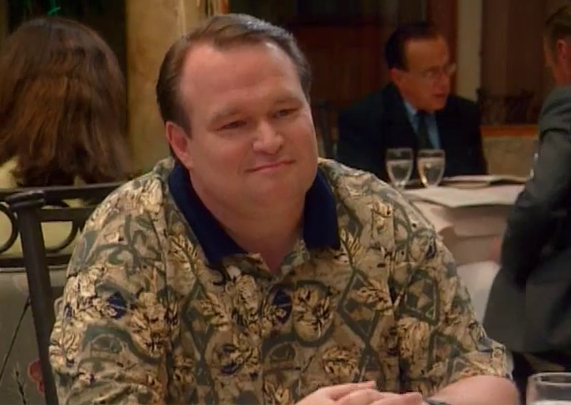
In Episode 15, “The Thong,” Larry David, at the request of Rob Reiner, reluctantly agrees to be the prize in a lunch auction to benefit Groat’s syndrome (which—let’s be clear—has nothing to do with former Pittsburgh Pirate Dick Groat). Larry eventually sits down to lunch with a man named John Tyler (played by Tom McGowan), who paid $4,000 for the honor of sharing a meal with Larry. This John Tyler not only is no relation to the president, but is completely dismissive of sharing his name. Determined to provide John Tyler with an entertaining and affable experience, Larry, grasping for conversational ideas, even serenades his lunch guest with a Marilyn Monroe–esque Happy birthday, Mr. President John Tyler

Now, Tom McGowan played the increasingly annoyed Ordinary John Tyler admirably, and the scene conjures a lot of laughs. However, it might have worked even better had McGowan’s role instead been played by one of John Tyler’s two surviving grandsons (who, at the time of filming, were only in their mid-seventies). Of course, it would have been pointless to have Lyon Gardiner Tyler, Jr., or Harrison Tyler play an unrelated man who happens to possess the name “John Tyler.” But had one of the grandsons played himself, upon Larry’s discovery of his lineage, there’s no way that Larry—a keen student of history both in the show and in real life—would ever have believed that the grandson of an antebellum president could be alive—thus yielding the absolutely ultimate Larry David stare-down as he tries to determine whether the man sitting across from him is telling the truth about being the grandson of the long-deceased President Tyler.

A Larry David stare-down a century and a half in the making—that would have been pretty…pretty…pretty…pretty good.


(Images of Larry David and Tom McGowan copyright HBO.) 

Monday, December 16, 2013

Opportunity Knocked on a Door That Shouldn't Have Been There

Jack Torrance’s “Heeerrreee’s Johnny!” head-poke through an ax-split door in 1978's The Shining is one of the iconic images in modern cinema and certainly the most identifiable on-screen moment of Jack Nicholson’s long and lauded career. But this classic scene would have been even better had the doorway instead been covered by a multi-colored curtain just like the one that Johnny Carson pawed through every weeknight at the start of The Tonight Show.

Many homes in the 1970s featured doorways adorned with tapestry dividers or hanging beads instead of doors, and the psychotic Jack Torrance popping his head through a vertically striped curtain of orange, pink, brown, beige, gold, and two shades of blue would have truly added cinematic provenance to this frighteningly comic moment.

True, Nicholson ad-libbed this legendary line, but once such a great idea was out of the bag, there’s no reason that Stanley Kubrick—notorious in Hollywood for shooting excessive takes—couldn’t have had an intern run out to a local linen store, order a replica Tonight Show curtain, and instructed Nicholson to redo the scene with the proper prop.

Frankly, I’m more than a little surprised that Kubrick—one of the most visionary filmmakers ever to step behind a camera and a renowned obsessive for detail—overlooked this opportunity.

Then again, Kubrick did have the good sense to cast Shelley Duvall rather than Robert Duvall as Jack Torrance’s wife, Wendy...


(Image from The Shining copyright Warner Brothers; image from The Tonight Show copyright NBC.)

Sunday, November 24, 2013

Kale-o, Newman! Could Newman Be the New Face of Kale?

I recently read that kale has anti-inflammatory properties. According to Carolyn Butler, writing in the Washington Post of September 25, 2012, kale—a leafy relative of broccoli, cabbage, and cauliflower—contains 45 different flavonoids that possess antioxidant and anti-inflammatory properties.

Quoting Deirdre Orceyre, a naturopathic physician at the Center for Integrative Medicine at George Washington University Medical Center, in that same article: kale has “a range of antioxidant and anti-inflammatory effects in the body.”

I immediately thought this would make for a great marketing opportunity for kale producers. Based on Newman’s “When you control the mail, you control... information!” rant in Episode 70 of Seinfeld, “The Lip Reader,” I urge the Kale Marketing Board, or whatever the hell exists that promotes the stuff, to hire Wayne Knight to reprise the scene in which he threatens Jerry with postal retribution for not letting him “borrow” his new lip-reading girlfriend. Nothing could better trumpet kale’s benefit to the human body than Newman reassuring the American public that “When you control the kale, you control…inflammation!” as he displays his not-so-inflamed hands.

Then again, as he did with kale’s unsavory cousin, broccoli, Newman would very likely take a bite and spit it out in disgust, exclaiming “Vile weed!” So maybe those kale folks should consider Frank Costanza as corporate spokesman—he probably doesn't find kale as distracting as tinsel... 


(Images from Seinfeld copyright NBC.)

Friday, November 1, 2013

Sometimes You'd Better Not Go Where Everybody Knows Your Name


Cheers was the sitcom of the 1980s. Combining relatable and lovable characters with witty punch lines, the Boston bar–based show reached the top ten in ratings for eight of its eleven seasons and remains one of the most beloved comedies in the annals of television.

Perhaps just as remembered as the characters themselves is Cheers’ opening credits, with its ultra-catchy “Where Everybody Knows Your Name” theme song and colorized archival photos of barflies who strongly resembled their onscreen counterparts.

Many viewers wondered about what the newspaper headline WE WIN! bragged. (The elderly bartender proudly holding up the paper is not intended to represent George Wendt’s character, Norm, whose counterpart is shown seconds before this; Wendt’s name merely remains onscreen as this implicit nod to the deceased Ernie “Coach” Pantusso concludes the opening credits.)

Looking closer at the contents of this newspaper, we can see that below the primary headline, on the right, it reads “As Cards Lose to Bu...”


This indicates that this famous local photo dates from the Boston Braves clinching the 1948 National League pennant. As the second-place St. Louis Cardinals lost, 2-1, to the Pittsburgh Pirates (the “Bu...cs”) on September 29, Boston simultaneously defeated the Brooklyn Dodgers, 4-3, concluding a torrid 18-6 September for the Braves and putting Boston up by 6 games. With only 5 games remaining for the Cardinals, the Braves had claimed their first pennant since 1914.

What doesn’t ring true in the context of the sitcom is that, by the time Cheers premiered in 1982, the Boston Braves were but a dim memory in Bostonian minds, having abandoned Beantown for Milwaukee after the 1952 season. Thus, the Braves hadn’t been part of Boston culture for three decades. Add to that the fact that Boston was, even during the Braves’ few glory years, undeniably a Red Sox town—with ex–Red Sox reliever Sam Malone giving the bar added Sox cachet—and the use of this photo seems deceptive.

Sure, Bostonians were rightfully proud of their Braves heading to the World Series—but those folks were dead or infirmed by the time Cheers was “open for business.”

Let’s be frank about that proud and pugilistically inclined city: Had a patron come into Cheers and openly rooted for the Atlanta Braves because he or she had remained a diehard Braves supporter from their days in Boston, those Cheers regulars would have beaten that fan with a ferocity that would have made The Depahted look like The Sound of Music.

Not to single out Bostonians, though—had an Oakland A’s supporter showed his true colors in Paddy’s Pub, you can be sure that Sweet Dee and the rest of the It’s Always Sunny in Philadelphia gang would have gone Smokin’ Joe Frazier on his traitorous ass.

(Images of Cheers credits copyright NBC.)

Tuesday, August 20, 2013

Me and the Lacewing: Could It Be a Chase Thing?

Two days ago, I met a friend in a corner bar in the Bella Vista section of South Philly. With the temperature surprisingly mild for an August afternoon, the pub’s many vertical windows were open to allow in the air. As my friend and I chatted, a pale-green insect I later identified as a green lacewing slowly flew between us and landed on the wall. Approximately three-quarters of an inch long, the green lacewing looks like a cross between a moth and a scallion. After each of us briefly commented on the odd-looking intruder, we returned to our conversation and left the lacewing to its business.

This morning, I was standing in my bathroom when an insect looking very much like the lacewing from two days ago fluttered through the doorway. Now, encountering two separate specimens of the seldom-seen lacewing within forty-eight hours is highly unlikely. However, the chance that the Bella Vista lacewing hitched a ride home with me seems even more implausible, because…

·         A plant-dwelling insect would not be drawn to a human, particularly for such a long duration;
·         My friend or I likely would have noticed if the lacewing had eventually landed on me;
·         I had to walk a block and a half to my car, giving the lacewing plenty of time to be lured away (or alarmed by the motion of my body);
·         Most importantly, with my car’s air conditioning not working, I drove to Bella Vista and home—largely highway driving—with both windows open, causing a very stiff cross-breeze that certainly would have sucked the lacewing out into the open air.

So, is it possible that the Bella Vista lacewing followed me in the same manner that Roxy the Yorkshire terrier navigated the ninety miles back to her home after Newman, Kramer, and Elaine dog-napped her in Episode 111 of Seinfeld, “The Engagement”?

If a dog could do it, then why not a nectar-seeking neuropterid? Unlike Roxy, the lacewing can fly and thus take a direct path to my apartment, avoiding the Walt Whitman Bridge and potentially confusing traffic patterns along Admiral Wilson Blvd. Furthermore, the lacewing had only seventeen miles to traverse, compared to the ninety miles that Roxy trekked from Monticello to Manhattan. (I assume that, with its compound eyes, the insect spotted the address on my driver’s license when I opened my wallet to pay the tab, because, despite its powerful mandibles, the lacewing did not bite off the tag of my shirt and fly to my apartment with it between its tiny jaws.)  
    
I can only hope that the lacewing will not keep me up all hours of the night with incessant barking, lest I be forced to get my neighbor to bug-nap the creature and drive it out to its native habitat at 8th and Fitzwater. And even if it does not hinder my sleep, I will be fortunate not to suffer nightmares of the lacewing savagely attacking me, to which Kramer fell victim after the incident with Roxy.


(Images of Kramer and “Roxy” copyright NBC.)

Saturday, August 10, 2013

Nary Anything Military About The Fugitive

At this very moment, The Fugitive is being broadcast on The Military Channel. In my opinion, The Military Channel is grossly misrepresenting itself and can claim no good reason to run this film. As Deputy U.S. Marshals, Tommy Lee Jones and his posse are law-enforcement agents under the aegis of the Department of Justice and are authorized to enforce federal laws and orders of the federal court system—they are not members of the United States military, nor, of course, are the film’s ancillary pursuers, the Chicago Police Department.

At no time, in fact, does The Fugitive feature any member of the U.S. military. (As can plainly be seen above, Dr. Richard Kimble is not being chased by soldiers, Marines, tanks, an F-16, a few drunk Coast Guardsmen, or even a measly Ticonderoga-class cruiser.)

That The Military Channel featured this “unmilitary” film is akin to the onerous act of individuals who falsely claim to have served in the armed forces or, worse yet, to have been decorated. And although The Military Channel’s action, technically, does not violate the Stolen Valor Act of 2013—which outlaws the “fraudulent representation about receipt of military decorations or medals ”—it transgressed the spirit, if not the letter, of the law.
Ironically, The Military Channel would have done better ethically to have aired a film as seemingly unsuitable as The Blues Brothers. Yes, these fine, Chicago-based films similarly feature outlaws hotly pursued by multiple law-enforcement agencies, tense moments on Lower Wacker Drive, and a riveting chase through Chicago’s Daley Plaza—however, unlike The Fugitive, John Landis’s raucous tale of two orphans on a mission from God makes a completely legitimate choice for Military Channel broadcast, because among Joliet Jake and Elwood’s myriad pursuers were a company of U.S. Army infantry, including military police and at least two Sherman tanks.*

* The Sherman had long been replaced in the U.S. Army—and is thus completely anachronistic—by the time The Blues Brothers was being filmed in 1979; however, it is not inconceivable that, in order to get heavy armor to the scene and apprehend the Blues Brothers as quickly as possible, tank crews would man a serviceable M4 Sherman if, for some reason, their current tank was not combat-ready.   

So jeers to The Military Channel for failing to air a film as worthy of America’s bravest as the exploits of Jake and Elwood Blues.

(Image of The Fugitive copyright Warner Brothers; images of The Blues Brothers copyright Universal Pictures.)