Sunday, January 12, 2020

Neil Peart Helped Me Find My Way

I spent the summer of 1981 sweaty and shirtless in my bedroom as I air-drummed relentlessly to Rush’s Moving Pictures. An inveterate desk-tapper through much of my schooling, I knew nothing about playing drums, having attempted it several months earlier in seventh-grade music class and coming off a fool thanks to my lack of coordination.

Still, instinctively seduced by a thumping, mesmerizing backbeat played almost as if a lead instrument, I sat for hours on the edge of my bed learning roundhouses and mimicking beats in time signatures I couldn’t determine—fairly competently before long, as I rosily recall—my concession to ignorance the misbelief that the snare drum is placed outside of the right knee, not between them, and unenlightened to the futility of performing two-handed snare work across my body on an actual drum kit.

Fully “awakened” to music’s magic only a few months earlier (during a genuinely epiphanic moment delivered by Jimmy Page in that same seventh-grade classroom), I, like so many soon-to-be Rush fans, turned onto the utterly unique Canadian trio through the ubiquitous radio presence of “Tom Sawyer” and “Limelight.” Electrified, I made Moving Pictures my first record purchase. Teenage-hood commenced the moment I dropped needle to vinyl.
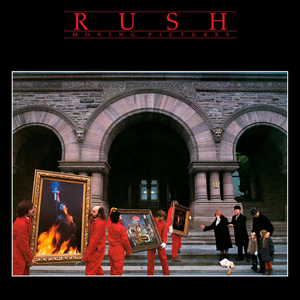
Yet it wasn’t just the dynamic music and stellar production: Rush’s secret of success lay in its mature, evocative lyrics. Rock never had particularly been the playground of the erudite, but first glance of the lyric sheet proved that this Neil Peart guy had weightier topics to poetize than unrealistic I’ll love you forever’s or frivolous paeans to sex, drugs, and rock and roll. Rush immediately captured my fascination—and nearly four decades later, it has not let go.

Several years would pass before actual drums lay beneath my flailing limbs, and even longer until I put pen to paper, but I quickly found a tenuous association with Neil. Growing up in a suburban neighborhood eerily reminiscent of that featured in its music video, “Subdivisions” caught me at the precise moment of teenage vulnerability—the Signals album being released the very week I entered high school. A tall, gawky freshman, lost in a sea of faces—most of them more appealing than mine—I was living the very words Neil expressed about his high school halls. Like Neil, I was a misfit, an outsider, maladroit at making either friends or conversation and virtually invisible to girls. I even resembled that confused, pitiable boy in the “Subdivisions” video, although, mercifully, I had exchanged my bulky, socially debilitating eyeglasses for contact lenses a year earlier (though that had not improved my self-esteem very much). Possessing no idea how to be cool and unwilling to conform, I was cast out.

Before high school ended, I was a drummer, and before college concluded, a lyricist as well, adding to that tenuous bond (albeit with a fraction of Neil’s talent and monastic discipline on the drummer’s throne). When I finally joined bands after college, I insisted on contributing lyrics and quickly became the primary lyricist because it was one of the few things in which I held implicit confidence. (Unlike Neil, I’ve always considered myself a lyricist first, a drummer second.)

Though Neil was less a direct influence on my lyric writing than Joni Mitchell, Bob Dylan, and Pete Brown, his commitment to integrity helped me refute the age-old stigma that drummers are incapable of writing compelling lyrics and that for a band to depend upon a drummer’s words is creative suicide. I could express myself in a way that I was never able to do verbally, opening up my life in a manner that I’d never dreamed and inspiring me to write lyrics of which I could be proud even though, as a Middletown dreamer, few would ever hear them. What a dreadfully barren existence I would have suffered had Neil not provided the example of mastering words as well as drums.

Neil Peart very likely had a more profound influence on my life than any other individual. He, Geddy Lee, and Alex Lifeson made life better, for me and countless others, often when life became oppressive—or even hopeless. That’s an incalculable legacy—an even richer one than the many songs and books Neil leaves us. Although, these days, I often lament my age—and how quickly I’ve gotten to it—I feel hugely fortunate to have been born when I was so that I could come of age at the very moment at which Neil’s words and Rush’s music could catalyze my restless dreams of youth. There very well might not have been anyone to fill that role had I been born at some other time.

Neil Peart deserves a Thank you beyond my capability for that.


Sunday, October 9, 2016

Salt Lake City Is No Place for All That Jazz


Countless professional sports teams have relocated when their financial situations became untenable in their hometown. It is a reality nearly as old as professional sports itself. Yet relatively few peregrine franchises choose to bring their nickname with them. And why should they? Sure, the Brooklyn Dodgers, New York Giants, Baltimore Colts, and Minneapolis Lakers possessed franchise monikers that were too deeply ingrained in the fabric of their sport—and too valuable in their marketability—to be rechristened, but owners are often eager to rename their incoming team something with indigenous appeal that will bring locals into the arena.

After all, why would the NHL’s Colorado franchise retain “Rockies” when moving to swampland whose most mountainous feature is the New Jersey Turnpike rising over the Hackensack River? Just as Denver would have proved très stupide to keep the Nordiques nickname in its new mile-high home.

And the Dallas Texans would have been dang suicidal not to have switched to the “Chiefs” upon arrival deep in the heart of Kansas City.

So it is perplexing that the NBA’s Utah franchise retained its Big Easy–born Jazz nickname.

Utah, and specifically Salt Lake City, is both the temporal and spiritual home of Mormonism. Mormonism, like most religions, is—at least in principle—a strictly codified belief system. In Mormonism’s case, guided by its 13 Articles of Faith. Its Book of Mormon contains a “history” far older than Christianity and is supplemented by lengthy scriptures such as the Doctrine and Covenants and the Pearl of Great Price. All in all, the Book of Mormon seems—from its own sources as well as interviews with “average” members of the Church of Latter-Day Saints—to be a highly regimented template of conducting one’s life righteously and steering clear of sin (even though Mormonism’s founder, Joseph Smith, and his polygamous congregation lived lives that made themeven by standards of their dayoutcasts of mainstream Christianity).

So, it goes without saying that straight-laced Salt Lake Cityhome of the Utah Jazzbears no cultural resemblance whatsoever to vivacious, hedonistic New Orleans. More to the point, jazz is the spiritual antithesis of religion—this most improvisational of art forms thrives on its lack of boundaries and its emphasis on personal expression. Whereas religion arose to curb the chaos of an uncivilized populace, jazz embodies, musically, that very chaos. Frankly, jazz never could have evolved in a button-down town such as Salt Lake City or a state as conventional as Utah—only the melting-pot, loose-moraled, devil-may-care streets of a city such as N’awlins could have birthed this deeply emotive and unpredictable art form. 


One need only look upon one of the great practitioners of personal expression on the basketball court, Pistol Pete Maravich—perhaps the John Coltrane of the hardwood—whose freewheeling style of play personified New Orleans and its Jazz franchise. Considering both that Pistol Pete was hardly the poster boy for Salt Lake City’s reverential atmosphere when he and his Jazz arrived in 1979 (Maravich was quoted in a biography of the same name as having no interest in Christianity during his playing days) and that, by 1979, Maravich’s days as a basketball virtuoso were behind him, it’s beyond baffling that Jazz owner Sam Battistone, Jr., didn’t rename the franchise.

So, why weren’t the Utah Jazz redubbed something closer to the city’s—and by extension, the state of Utah’s—heart?

Such as for what Salt Lake City is truly knowneven more than its homegrown religion and choir:

Salt, of course.


Long in the vanguard of team names utilizing a collective noun, Battistone could have continued that fashion by rechristening his NBA franchise the Utah Salt. After all, the Great Salt Lakesitting just west of the city founded by Mormon bigwig Brigham Youngis larger than Rhode Island and, on occasion, Delaware, providing both Utah’s capital and the state, itself, with its foremost secular identity.

And the marketing opportunities didn’t end there. The Utah Salt would be ripe for a third jersey: the “NaCl.” Similar to “NOLA” of New Orleans renown, “NaCl” would represent both the chemical formula of table salt and, when either read or spoken as a quasi-nickname for the team, a hip phonetic reference to Salt Lake City’s famous Mormon TaberNACLE Choir.

Such a marketing plan even could have included the rallying cry “Get the NaCl” to capitalize on the Get the Knack album and its single, “My Sharona,” that debuted just four months before the Utah Jazz played its first game and were each massive No. 1 hits by then. A lawsuit likely would have ensued, but a quick settlement would have provided invaluable buzz for the fledgling team and been well worth the legal wrangling.

Who could have predicted that young jazzmen going west would culminate in such a lost opportunity?


Thursday, October 6, 2016

A Tris Speaker Sing-along


(They Call Me) Tris Speaker

Click the YouTube link at bottom and sing along...

I’ve clubbed them for pairs
I’ve slugged the most doubles
I’ve hit almost as many
As stars seen by Edwin Hubble

They call me Tris Speaker
I’ve been roundin' first so spry
I won’t get the fame that I’m after
’cause of a guy named Ty

I asked Stengel, Charles Dillon
Who was Speaker’s equal?
He perfessor’ed back to me
There was only one Gray Eagle

They call me Tris Speaker
Ive been roundin’ first so spry
I won’t get the fame that I’m after
’til the Hall opens in ’39

People tend to rate me
In the middle of the pile
As I ransack their fields
And ruin pennant plans
Focusing on home runs
Not the records I’ve compiled
I’ve got more doubles
Than Rose, Cobb, and The Man

I won’t get the fame that I’m after
’cause of a guy named Ty

I learned how to cut down base runners
In assists, no one’s within a hundred seventy-five
I was happy in Boston, even more in Cleveland
I’m most valuable in socks of red, blue, or argyle

You’re lookin’ at me
I’m lookin’ for two
Once you pitch that ball
There ain’t nothin you can do

They call me Tris Speaker
I’ve been roundin’ first so spry
I won’t get the fame that I’m after
’til the Hall opens in ’39

I won’t get the fame that Im after
’til the Hall opens in ’39

Tuesday, October 4, 2016

Atlanta's Fiery Nickname Flamed the Fans Rather Than Fanned the Flames

Apart from the Braves, Atlanta has never enjoyed much success as a sports town. In 50 seasons, the Falcons have lost nearly 57% of their games—yielding the fourth worst winning percentage among all 32 current NFL franchises. Reaching the Super Bowl but once, Atlanta lost handily to the Denver Broncos in 1999. Unlike their sharp-eyed namesake, the Falcons have possessed poor vision and rarely drafted well. This team 250 miles from the Atlantic Ocean somehow also spent the bulk of its existence in the same division as the Los Angeles/St. Louis Rams and the San Francisco 49ers, long-time powerhouses that took turns beating up Atlanta for three decades and left it little room for playoff hopes.

And since emigrating from St. Louis in 1968, although the Hawks have qualified for the playoffs more often than not, their hoop dreams have fallen achingly short season after season. Even Hall of Famers Dominique Wilkins and Pistol Pete Maravich—freshly off NCAA superstardom—could not lead Atlanta even to the finals. Consequently, the Hawks have perennially ranked among the worst in NBA attendance since arriving in Georgia.

But the Falcons and Hawks largely are cases of subpar general management and small-market struggle. 

Atlanta’s original hockey team, the Flames, is an altogether sadder story: Born in 1972, the Flames were the first franchise to bring NHL hockey south of the Mason-Dixon line—no easy going for a fledgling team competing for talent with the brashly spending World Hockey Association. But General Manager Cliff Fletcher drafted shrewdly and acquired skilled youngsters who made the Flames competitive almost from the get-go. Led by such gritty skaters as Tom Lysiak, Eric Vail, Bobby Leiter, Pat Quinn, Guy Chouinard, and the exciting goaltending tandem of Daniel Bouchard and Phil Myre, Atlanta reached the playoffs by its sophomore season, after which it never failed to finish at least .500.

Unfortunately, the promising Flames contained a fatal flaw: Owner Tom Cousins (already the owner of the NBA Hawks) named the franchise after General Sherman’s burning of Atlanta. How Cousins—a native Atlantan—could select such a mind-blowingly inept name is beyond comprehension. Even today, the city’s torching at the hands of Sherman’s army is a sore spot for deep-rooted Atlantans, some of whom still refer to the Civil War as the “War of Northern Aggression.” And if Atlanta’s ignominy continues to be a touchy subject now, it was even more so in pre–politically correct 1972, when Jim Crow and Civil Rights remained fresh wounds in the Southern psyche. Why would Cousins risk alienating his fan base by reminding them daily of their city’s ultimate humiliation?

The fact is that, for all of their success and promise, the Flames never drew well. Attendance dwindled throughout the 1970s, and the franchise relocated to Calgary in 1980. But forget the dearth of Stanley Cups and superstars—the Atlanta Flames’ failure can be blamed solely on its name. Let’s face it: If you’re going for the perpetually popular Civil War angle, at least name your team the Atlanta Hydrants so as to fill potential fans with the defiant hope that their city and their homes will be spared rather than bashing already-fragile Confederate egos by reminding them of the cinders their ancestors’ homes became.

Sure, a logo of a hydrant isn’t as flashy and inspiring as a flaming “A”—but who cares how good a uniform looks when traumatized spectators are too frightened to leave their homes for fear of Blue Bellies setting torches to their town?

Friday, October 2, 2015

Spahn and 750 Games—How’d He Keep His Numbers the Same?


As a young southpaw, I naturally felt an affinity for major league left-handers. Lefties, by nature, are outsiders. The consensus of sources spanning more than three decades states that only about 10 percent of the population is left-handed, making we portsiders indeed a rare breed. I, personally, never experienced the forced switching of penmanship meant to “cleanse” left-handed schoolchildren of earlier generations—a barbaric act harmful to the esteem, if not to the wiring of the brain itself. However, I was encouraged to slant my lined paper at a right-hander’s angle. And many a classroom offered a dearth of one-piece desks built for left-handers, my left elbow hanging humiliatingly in midair while my “normal-handed” classmates wrote in fully supported olecranal luxury. 

When you’re left-handed, it dominates your whole being in a way that the majority of the world cannot understand simply because the world is fitted to them.

Still, even from a young age, I was told that baseball teams are forever on the lookout for left-handers who can throw with control, which made me feel special, even if my backyard catches with Dad hadn’t yet graduated from tennis ball to horsehide.

Thus, it’s no surprise that I possessed an innate connection to southpaws who took the mound at Veterans Stadium, on television, and on my baseball cards. Hometown Phillies Steve “Lefty” Carlton, Tug McGraw, Jim Kaat, and Randy Lerch (a lefty with my name!). Randy Jones (a Cy Young–winning lefty with my name!). Don Gullett, Mickey Lolich, Fred Norman, Paul Splittorff, Frank Tanana, Jerry Koosman. And, of course, the deity of all southpaws, Sandy Koufax, who, though just before my time, commanded the highest respect in my household because the electrifying southpaw, by virtue of his Jewish heritage, single-handedly revived my Flatbush-born father’s interest in baseball after his beloved Brooklyn Dodgers broke his heart. (Sadly, that renewed vigor for the game once and for all abandoned my father with Koufax’s retirement.) 

Of course, I also knew of the great lefties of old: Lefty Grove, Lefty Gomez, Eddie Plank, Carl Hubbell, even Babe Ruth himself! But the southpaw who loomed largest, of course, was Warren Spahn. One of my baseball magazines contained his lifetime record. Thirteen 20-win seasons. Thirteen?! And a win total, 363, to which no other lefty stood remotely close. For me, and perhaps other young southpaws, 363 became something akin to 714 and 4191, an instantly identifiable benchmark in baseball history that spoke for itself.

But in examining Spahn’s record more closely, one finds a statistic that is both so ironic and improbable as to almost defy belief.

During a career in which Spahn pitched 363 victories, the multitalented hurler also recorded 363 batting hits.

When one takes into account the myriad variables that go into this mind-boggling confluence—from the fact that a starting pitcher’s at-bats vary from game to game depending on how well his hurling keeps him in each contest, to the fact that Spahn relieved in 85 games, further fluctuating his at-bats—one wonders how something so weird could happen. And then there’s the additional confounding variable that Spahn appeared in 18 games as a pinch-hitter, which chance would likely employ to further skew two totals rather than bring them together.

Macroscopically, how could one total derived from a pool of 750 (games) end up equaling another from a pool of 1872 (at-bats)—especially considering the first is accrued at a maximum of one per game whereas the second is almost always accrued multiple times per game?

It is for strange cases such as this that I wish I were a mathematician so that I could calculate the odds of two wholly unrelated totals, incurred at vastly different per-game rates (0 to 1 for wins; 0 to infinity for hits), somehow matching up perfectly over the course of 21 seasons. Still, it doesn’t leave me exactly hollow to state abstractly that the chance of both totals landing on 363 is merely astronomical.

Even considering that Spahn possessed an uncanny (though surely unrealized) knack for knocking as many hits in a season as he tossed victories—Warren authored 11 occasions in which his win total of any given season equaled his hit total of any given season, including an incredible eight times in the same season—the fact that 10 seasons not only did not match but varied in range from 0 to 21 for victories yet from 1 to as high as 36 for hits still makes this statistically improbable in the extreme.
Yet there exists another layer to this algebraic madness.

Spahn, who seemed as if he would continue winning forever, going 23–7 at age 42, finally was snared by Father Time in 1964. After suffering only his second losing campaign since breaking into the big leagues more than two decades earlier, he was purchased from Milwaukee by the young New York Mets just before Thanksgiving.

As the ledger closed on his Braves career, Spahn boasted 356 victories—again, the exact number of hits he notched as a Boston/Milwaukee Brave.

Struggling through 20 games with the ever-floundering Mets, Spahn staggered to a 4–12 record, his bloated 4.36 ERA hardly helping the punchless New Yorkers. Yet in those 20 games, as well as one in which he pinch-hit, Spahn collected four hits, equaling his victory total.

Going nowhere, New York released Spahn on July 17. Two days later, the San Francisco Giants, tangled in fourth place yet only 5½ games off the lead, signed Spahn, hoping to coax a last bit of magic from his left arm for the stretch drive. Perhaps revitalized by taking the mound once again for a contender, Spahn pitched better, for a time. He cut his ERA by nearly a run and chipped in three victories, although his last five appearances were spent in relief, as the Giants came up two games short at the wire.

Yet with eerie consistency, Spahn once again managed to rap as many hits as victories, rapping a trio of singles to match the 3–4 record he put up with San Francisco. The Giants released Spahn after the season, ending his remarkable major league career.

Not only had Spahn managed to produce equal victory and hit totals across 21 seasons (interestingly, he stroked his first hit in 1942 yet had to wait, because of highly decorated military service in World War II, until 1946 for his initial victory), but he, improbably, registered matching numbers of hits and victories with each franchise for which he played.

Such a quirk in the statistics seems only to make already-astronomical odds exponentially longer.


Were I capable of calculating the odds of merely accruing 363 for both totals across a career as long as Spahn’s, then trying to do so while including the further factors of identical sums across three franchises might cause my calculator to explode. It simply doesn’t seem as if it could happen.

And if all that weren’t enough, the breakdown of Spahn’s corresponding pitching wins and batting hits achieved as a Brave by city very nearly match as well: As a Boston Brave, Spahn won 122 games while collecting 120 hits, which, of course, leaves his totals after the franchise moved to Milwaukee Brave at 234 pitching wins and 236 hits.

Then again, neither did the probability of a pitcher not winning his first major league game until age 25 yet going on to win 363 for his career.  

Wednesday, October 22, 2014

! Spy Too Many Exclamation Points on !-95

While driving home from Florida, I passed this sign yesterday, which stands at Exit 169 on the southbound side of I-95 near Florence, South Carolina. It looks to me like writer Jake Jarmel now manages the Triple T Truck Center and he hired on-again-off-again girlfriend, Elaine Benes, to edit his billboard.

Of course, Elaine, upset that Jake’s latest endeavor lacked a certain emotion and intensity, apparently added unnecessary exclamation points—ostensibly to connote such messages as:

“It was a damp and chilly afternoon, so I decided to drive my semi!”

and

“I pulled the lever on the clutch, but the truck’s engine wouldn’t start!”


Okay, the dialogue implies a plot so banal that an inordinate number of exclamation points may be the only thing keeping this truck-repair place from being boarded up in bankruptcy, but Mr. Lippman isn’t going to see it that way and will want those exclamation points gotten rid of, should he drive by…


(Images from Seinfeld copyright NBC.)

Sunday, September 28, 2014

Maybe the "T.S." Stood for "Terribly Similar"...

Jesse Lee Tally, known as “Doc” Tally, played baseball for the barnstorming Israelite House of David team from 1914 to his death in 1950. The House of David was a religious commune founded in Benton Harbor, Michigan, in 1903 and thrived through the 1920s and 30s. Its founders—not the most visionary of religious leaders—declared sex a sin (even for procreation), in principle dooming their movement after a single generation.

The House of David became a national phenomenon during that time for fielding a long-haired, long-bearded evangelizing baseball team (actually, several teams) that crisscrossed the country playing amateur; semipro; and professional opponents, including squads from the major, minor, and Negro Leagues. Sort of the Harlem Globetrotters of baseball, the House of David team grew famous for its fancy, yet very formidable, play. It even, for a time, boasted several former Major League greats, including Three Finger Brown and Grover Cleveland Alexander, as well as the legendary Negro Leaguer, Satchel Paige—all of whom were required either to grow their whiskers or don a fake beard.

The House of David even beat the Major Leagues to night baseball, playing its first game under electric light in 1930—five years before the Bigs. (Ever shrewd in enlarging opportunities to play for paying customers, the House of David brought portable lights on its buses to allow night games.)

Anyway, I find Jesse Lee Tally the spitting image of the recently deceased Robin Williams. Reputedly the House of David’s best player, Tally invented the famous pepper games with which players would wow crowds with their acrobatic and dexterous skills before, and during, contests. Tally thus seems like the same type of good-natured, entertaining ham that Robin Williams came to be. Interestingly, Williams, a Chicago native, was born little more than a year after Tally’s death and just a hundred miles from Benton Harbor.*

* Perhaps stranger still, Williams starred in the resemblant-named 2004 “dramedy,” House of D.

It’s almost as if Jesse Lee Tally’s spirit entered the newborn Robin Williams’ body in 1951—all it had to do was float to the far side of Lake Michigan, and it had more than a year to do so…


So, it is entirely possible that Robin Williams possessed great baseball potential, even if he never sensed it. However, the world is a better place for him taking the route that he did—not only because he left a legacy of laughter, but because Williams’ natural inclination to field a batted ball, then toss it in the air while declaring, “Fly, be free!” would have led to a catastrophic amount of unearned runs…      

(Image from Good Will Hunting copyright Miramax Films; image from Mork and Mindy copyright ABC.)

Thursday, September 25, 2014

No Breakdown of Communication at 7-Eleven

I walked into my local 7-Eleven last evening, and the radio that’s always kept at the back of the store, next to the freezers, was playing “Communication Breakdown”—one of my favorite songs by one of my favorite bands. Sadly, Led Zeppelin, following John Bonham’s death, disbanded just before I grew old enough to attend rock concerts (i.e., afford a ticket), so I never got to see them play live (although I have seen each surviving member perform solo).

Even so, getting to hear the Mighty Zep launch into one of its most molten tunes from as close as just to the right of the Ben & Jerry’s pretty much made up for it. Naturally, I stayed for the entire song, blithely disregarding potential post-concert traffic hassles awaiting me in the parking lot.

Now if I could only get to hear the Jimi Hendrix Experience at my local Sherwin-Williams...  

Friday, September 5, 2014

Over There...Over There...Why'd They Put All the Words Over There?

Today is the 100th anniversary of the start of the First Battle of the Marne, the week-long bloodbath that marked one of the first major clashes of World War I. Fought just east of Paris, this Allied victory prevented the Germans from reaching the French capital and making quick work of the war. Unfortunately, with more than half a million casualties laying dead or carried off the battlefield, the First Battle of the Marne also set the pattern for the devastating trench warfare that turned much of France and Belgium into killing floors over the next four years—a pattern of seesawing advances and retreats so futile that, nearly four years later, witnessed another major clash along the River Marne.

Known, of course, as the Second Battle of the Marne (above), this smaller, but still murderous battle halted the German advance in the summer of 1918 and hastened the Axis’ surrender. More than 132,000 Allied soldiers were killed or wounded in this three-week struggle, including 12,000 Americans.

County Route 537, which passes less than a mile from my home in its long trek across the breadth of New Jersey, is known within the limits of Mount Laurel, Hainesport, and Mount Holly as Marne Highway. Commemorating the great sacrifice of American doughboys in that second sanguineous battle, a blue historical marker is mounted on a Marne Highway road sign just west of the intersection with Larchmont Blvd. The problem is that the marker—a small-fonted, two-paragraph explanation of the Second Battle of the Marne—stands approximately 150 feet from the stop-lighted intersection. There is no shoulder in which to pull over (and if one did, one’s car would dangerously—and illegally—obstruct the right-turn-only lane that begins a few feet beyond the sign). Furthermore, there is no hope of gleaning more than a sentence of the marker even while decelerating toward a red light. (Imagine trying to read the sign above while moving at anywhere from 25 to 50 mph—hell, try reading it right now!)

Thus, the only possible practical way of actually reading this small acknowledgment of American contribution to that pivotal battle is to be stopped in traffic backed up from the intersection, which, although a line of traffic often does form there, hardly ever backs up that far.

Or one could simply walk over to the sign and stand just a few feet from the roadway to read it—a monumentally inconvenient and not-entirely-wise option, especially on that stretch of non-residential road flanked by daily-active railroad tracks. (This is exactly how I took this photo, walking home from the auto-repair shop a quarter-mile down the highway from this intersection.)

Sure, one could keep driving around the block, hoping to glean the entire message a line or two at a time with each drive-byand this might just be most in the spirit of Great War stupidity, as driving around this block entails an approximate 2.2-mile trek, including three traffic lights, because none of the streets within this block exit to another side of it. I guess a family could make a day of this by driving down Marne Highway, spying a line or two, turning right onto Larchmont Blvd., eventually merging onto Route 38 West, making another right onto Hartford Road, taking it back to Marne Highway, turning right, and again driving by the sign at approximate 7-minute intervals until the reading is complete (there is an Italian restaurant, Chinese takeout, and a 7-Eleven on the opposite side of the Marne HighwayLarchmont Blvd. intersection should a family wish to stop for lunch during their reading). I suppose a savvy couple or family could pre-plan for each member to simultaneously read a different section of the marker, which, if performed and recited correctly and in order, would drastically cut down on the time, effort, and gasoline expense involved. But this is not an easily executed strategy and could backfire catastrophically—like many a World War I offensive. 

Thus, to say that this historical marker was poorly planned and futilely placed is an understatement—also very much in keeping with World War I, itself, given the many atrocities perpetuated by idiotic generals who, time and again, ordered regiments of men “over the top” and into the waiting graveyards of no-man’s land.

So Im torn...

If the State of New Jersey (or perhaps Burlington County) allocated the expense and effort to commemorate the battle at all, then why not do it right and set the sign where it could actually serve its purpose instead of in a place where its words would surely go to waste? It seems certain that the genius employee of the state/county/township responsible for the placement of this historical marker was the great-grandchild of one of those World War I generals who so asininely sent their men off by the thousands to certain death for a few dozen muddy yards...

Did the war to end all wars teach us nothing about historical-marker placement? You can bet the Flemish sited their markers in readily accessible, easily readable locations.

And yet for all of its seeming idiocy, perhaps the Marne Highway historical marker is perfectly placed, ideally echoing the utter absurdity of the Great War, as if it were a modern-day, metal-plated Zimmerman Note.

Only Americans possess such a sense of irony...

Friday, August 29, 2014

With Twitter Abuzz About Keys of Bees, 'Twas Time to Channel Stevie and McCartney

This scientific fact has recently been making the rounds on Twitter: Bees normally buzz in the key of A, but when theyre tired, they buzz in the key of E.

No, I neither own a piano nor play the piano—but that didnt stop me from tickling the Ebony and Ivories about this bee-musing fact and writing a song that goes a little something...like this:

Every bee that I can see
Buzz together in the very same key
Side by side in their hive or swarming, oh lord, theyre after me

We all know that bees bring the news in Sacramento
There is good and bad in every bee
Some are humble, some will bumble
But they wont bother us if we mind our own beeswax, thats a fact

Every queen in Ulees apiary
Could breed drones for a ten-pound beard of bees
Side by side in their hive or swarming, oh lord, theyre after me

We all know that bees buzz in A less their lids are low
There is sweet nectar in every bee
Some make honey, some cause you fright
E is the key when bees dont have the might to take flight


Every bee has got no knees
Its a phrase that was made up falsely
If Sting got stung, the beed die and hed cry profusely
John Belushi was killer singing Im a King Bee

Every bee that I can see
Buzzing together in harmony
Ruth Buzzi so funny
As angry Gladys Ormphby
Ruth Buzzi socked it to me
When whacking dirty, old Arte

(Fade)

(Image of Bumblebee Man copyright Fox Broadcasting; image of John Belushi copyright NBC.)

Saturday, August 9, 2014

If Only Clubber Lang Had Taken on Pyongyang...

Im watching a M*A*S*H episode from 1981. Thankfully, MeTV runs restored versions of M*A*S*H that include scenes, or parts of scenes, long ago hacked out by greedier broadcasters squeezing episodes for every last second of commercials. Some of these scenes likely have not been shown for decades—I certainly dont recall a lot of them despite being a M*A*S*H aficionado since the mid-70s. 

Tonight, it was Episode 223, “Give ‘Em Hell, Hawkeye,” in which Capt. Pierce, fed up with year-long peace talks that have achieved nothing, pens a letter to President Truman, narrating it in voice-over as he writes. And as Hawkeye writes his letter, he refers to Harry—in newly restored dialogue—as “Mr. T.”

Now, the actual Mr. T, Laurence Tureaud, took that name in the late 1970s, but he was, by and large, anonymous until appearing as “Clubber Lang” in Rocky III, which debuted over Memorial Day weekend in 1982.

So, clearly, Hawkeye using the name “Mr. T” in an episode filmed nearly a year earlier is unrelated to the yet-to-be celebrity of Mr. T.*

But I can’t help wondering: if Mr. T had only become a Hollywood name a matter of months earlier, he could have actually portrayed President Truman in that M*A*S*H episode (M*A*S*H already had a long history of employing young, ascendant actors in guest roles). I see the episode as a two-parter, in which President Truman, “Mr. T,” responds to Hawkeye with a letter of his own—and, as did Hawkeye, narrating his reply in voice-over as he authors it...perhaps over a montage of his training regimen in the Oval Office, such as jumping rope, using a speed bag, or whatever else passed for hardcore cardio training in the early 1950s. 

Dear Capt. Pierce,
Thank you for your letter pleading for me to end this police action. However, you don’t seem to understand politics. One doesn’t back down from international threats to peace. South Korea was attacked. Attacked! You get it? If that little man, Kim Il-sung, don’t wanna come to the peace table, then I’ll come to him. The United States is ranked No. 1. ONE! That means we’re the best. But that bum has been taking the easy matches, sneak-attacking its peaceful neighbor. I’m telling you and everybody else at the 4077th: the United States will fight North Korea anywhere, anytime, for nothing. No, I don’t hate Kim Il-sung…but I pity the fool, and we will destroy any man who tries to take what we got.  

In closing, my prediction for the war: pain. 

Yours sincerely, 
President T

With aggressiveness that would’ve made Gen. Douglas MacArthur look like a Salvation Army bell ringer and accountability that would’ve left Harry S. Truman resembling a shriveling buck-passer, Mr. T might well have provided a ratings spike and seriocomic possibilities encouraging the stable of M*A*S*H writers to continue for several more seasons—perhaps even long enough to necessitate a romance between Hot Lips Houlihan and SSgt. Rizzo that would have perfectly encapsulated the lunacy of war...not to mention paved the way for either the best or the worst spin-off in television history.

*Far predating this M*A*S*H episode, a Welcome Back, Kotter spin-off called Mr. T and Tina briefly ran on ABC in 1976, but the show was so short-lived and obscure that not even its star, Pat Morita, remembered it. Perhaps if he’d come up with the “Crane” a decade earlier…

(Image from M*A*S*H copyright CBS.)

Sunday, August 3, 2014

We All Lifted a Yellow Submarine...

So, I just turned on the TV and caught the last ten minutes of The Three Stooges in Orbit (1962), a film I hadn’t seen since I was a kid. And in that brief span, several elements immediately jumped out as closely presaging subsequent films—to the point that I wondered more than just fancifully if this predictably insipid film filled with recycled jokes and made on the cheap for a very over-the-hill comedy troupe could actually have been the source of certain concepts used in later, higher-profile works.

Look at the propeller-powered flying submarine stolen by the Martians (above). Is this not practically a real-life, full-scale model of the Beatles’ yellow submarine depicted in the 1968 animated feature film? The Three Stooges in Orbit predated Yellow Submarine by six years—yet looking at the similarities in concept and design, it’s not hard to suppose that the director of the Beatles’ film, George Dunning, was a Three Stooges fan who caught their movie upon its theatrical release,* perhaps even screening it privately six years later for the crew of animators to give them a definitive sense of the artistic style he wanted.

* In 1962, Beatlemania hadn’t yet swept England, so Dunning, a Canadian expatriate who had yet to become associated with the Beatles, likely was walking around London with little to do and thus had plenty of free time to see the new Three Stooges film.

Moments later in the film, Professor Danforth, played by long-time quasi-Stooge, Emil Sitka, displays an animated television segment of the Stooges dancing to stock, early 60s pop music. This is perhaps even stronger proof that George Dunning and his crew lifted ideas from this Three Stooges film. As you can see, that’s impressively sophisticated animation for 1962—and it appears very much the progenitor to the dazzling animation of Yellow Submarine. Granted, the Stooges weren’t as limber as the girl dancing to “Lucy in the Sky With Diamonds,” but their particular brand of fat, elderly elegance must have made a lasting impression on Dunning.

Okay, this weakest incarnation of the Three Stooges is no “Fab Four,” but consider the cumulative work of Moe, Larry, Curly, and the criminally underrated Shemp—that’s a four as fab as John, Paul, George, and Ringo, for sure.†

† Continuing the numbers game, the Three Stooges and the Beatles each counted six participating members among their ranks: the aforementioned four in each group, plus, of course, latter-day Stooges Joe Besser and Curly Joe DeRita as well as Beatles’ castoffs Stuart Sutcliffe and Pete Best.

Furthermore, the Three Stooges went into widespread television syndication in 1958, introducing them to a new generation—the Beatles’ generation. With the future Beatles all in their highly impressionable teens at that time, it’s a good bet the lads watched and enjoyed the Stooges’ tomfoolery—especially the angry, young man of the fledgling group, John Lennon, who probably would have appreciated them most. I can easily see the Stooges’ violent tendencies having rubbed off on the volatile Lennon. (The Three Stooges was actually removed from syndication for a time in the 1960s when mothers complained that their children were emulating the Stooges’ dangerous antics.) Now, I’m not saying that a few episodes of Moe bullying Larry, Curly, and Shemp led to Lennon kicking original bassist, Stuart Sutcliffe, in the head—as has occasionally been alleged in the cause of Sutcliffe’s untimely death—but I am saying that an irate John likely was not above rapidly fluttering his hand in front of Sutcliffe’s entranced gaze, then snapping it down briskly, causing Sutcliffe’s head to do the same. Whether that facilitated Sutcliffe’s fatal cerebral hemorrhage, no one will ever know—but it sure looks like a lot of stress on the brain…

As an aside, yes, the Beatles’ animated TV series (which the Fabs had nothing to do with production-wise) debuted a month before The New Three Stooges cartoon in autumn 1965. However, the Three Stooges’ animated series included numerous live-action segments, so it’s highly probable that The New Three Stooges began development before the Beatles cartoon, although there may not have been enough time to permit cross-pollination specifically between the two shows.

Having presented all of this evidence, it cannot be overlooked that any discussion concerning the Three Stooges’ influence on the Beatles begins with the fact that Moe was wearing a Beatles’ haircut before any of the lads were born; thus, the Fab Four owe their most defining physical characteristic to Moe Howard.

But I’m not positing that The Three Stooges in Orbit was a creative well from which only the Beatles drew ideas. Far from it. Though meant to look comic, the Martians in this film actually appear disturbingly grotesque—even more so when the viewer subconsciously realizes that they strongly resemble the horrifying Grendel in the 2007 CGI version of Beowulf—or rather, that Grendel strongly resembles them. One wouldn’t think that the creators of a faithful and brutally explicit retelling of a violent Dark Age tale would look to a Three Stooges film for creative inspiration, but compare the Martians’ distended skulls, heavy eyebrow ridges, and lacertilian digits to Grendel and try to deny a connection…

Of course, Moe Howard—by several accounts, well-read in his youth and possessor of two months of high school study—may, himself, have based the Stooges’ brand of aggressive comedy on the original Beowulf

And as game-changing as was the granddaddy of all science fiction films, Star Wars,  it’s glaringly obvious from where in his movie-going youth George Lucas later pilfered the concept of the Empire’s ultimate weapon, the Death Star...


(Images from The Three Stooges in Orbit copyright Columbia Pictures; images from Yellow Submarine copyright United Artists; image from Beowulf copyright Paramount Pictures.)

Monday, July 28, 2014

Costner’s Arms Caused Draft Day Harm

According to the Web site Box Office Mojo, as of June 18, 2014, the Kevin Costner film Draft Day grossed $29.4 million worldwide. Against a budget of $25 million, this constitutes a major disappointment for Lions Gate Entertainment.

I was not among the few who forked over money to see a film that, seemingly, only a rabid, foaming-at-the-mouth football fanatic given a free bucket of Milk Duds could tolerate. However, it’s clear that, apart from the insipid drama of the behind-the-scenes string-pulling that occurs on the NFL’s most crucial day of the off-season, the prime reason why Draft Day failed at the box office is Costner’s glaringly obvious lack of range as an actor.

I mean, compare his performance in Draft Day (above) to some of his major roles over the last quarter-century. Clockwise from upper left, in Field of Dreams, JFK, Wyatt Earp, Jack Ryan: Shadow Recruit, and A Perfect World, Costner’s standard acting technique remains unchanged. It matters not whether he’s portraying a historical figure such as New Orleans District Attorney Jim Garrison or Old West lawman Wyatt Earp, or if Costner’s role is a completely fictional character—he has not altered that cool, calm, arms-crossed stance that so defines his image across the decades.

Sure, arm-crossing is called for in some roles—but to keep drawing from that well for one’s entire career is to sabotage that career by desensitizing the audience. “We no longer care that he’s acting casually confident—he’s done it,” filmgoers clearly said by staying away from Draft Day in droves. Do we really need more proof of the potential of arms on the screen than Molly Shannon in Episode 156 of Seinfeld, “The Summer of George”? Letting her arms “hang like salamis” as she “lurches around like a caveman” led to interoffice chaos.

And the less said how disastrous is Raquel Welch’s lack of arm movement in that episode, the better…
 
Okay, said arm-swinging led to a pair of arousing catfights involving Elaine…but who wants to see Kevin Costner in a catfight, even if it were to produce the drama Draft Day so sorely missed?

The bottom line is that arms = conflict. Can you imagine the bore-fest Raging Bull would have been had DeNiro stood scene after scene in the ring with his arms crossed? You can’t throw the title and pathetically destroy your career and reputation if you don’t first move your arms to punch and win the title...

Perhaps I’m being too harsh on Costner. He could well be an unknowing victim of Hollywood typecasting, selected for these roles solely because of his experience and proficiency in characters that cross their arms—not unlike Marlon Brando, whose outstanding ability to ooze psychotic torment by grabbing his skull landed him many a classic role.

So I suppose I’ll cut Costner some slack and give him until Draft Day II: I Can’t Believe They Green-Lighted This One Also to sort himself out…

(Image from Draft Day copyright Summit Entertainment Lions Gate; image from Field of Dreams copyright Universal Pictures; images from JFK, Wyatt Earp, and A Streetcar Named Desire copyright Warner Brothers; image from Jack Ryan: Shadow Recruit copyright Paramount Pictures; image from A Perfect World copyright Malpaso Productions; image from Apocalypse Now copyright Zoetrope Studios.)

Saturday, July 26, 2014

This Guy's Got a Little Too Much Nike on the Psyche

These photos have recently made the rounds on reddit.com. I know nothing of their source nor the reason for the drivers unorthodox technique.

My guess is that hes constantly saying embarrassingly asinine things.

Or perhaps hes suffering from a particularly virulent case of Aphthae epizooticae.

If the former, we can only hope that this man is en route to sensitivity training; if the latter, that hes on his way to a top-notch veterinarian.


Then again, I suppose this could be a pre-2005 photo of him placing a call on his mobile to Don Adams. (Laws prohibiting using a phone while driving were not widespread or well-enforced back then...)

Friday, July 25, 2014

It's Not a Lie...if You Believed It in 1937

Beg, Borrow or Steal, a rather obscure comedy from 1937, aired on the Turner Classic Movies channel this afternoon. Its description in the Comcast grid:

As a gesture, an American in Paris invites his daughters wedding party to his nonexistent châteauand they all accept.

This plot sounds remarkably similar to Seinfeld Episode 171, The Wizard, in which George Costanza is caught in a lie to his would-have-been in-laws, the Rosses, about not being able to attend a charity event on behalf of his deceased fiancé because he is closing a lease on a house in the Hamptons. When the Rosses dont call him on his lie, an infuriated George decides its time to get nuts and takes it up a notch by inviting the Rosses to his new summer home. Hilarity ensues when the Rosses call his bluff, and George spends two painfully awkward hours driving them to the very end of Long Island, all the while describing in exquisite detail his nonexistent house, including two solariums and a pair of horses, Snoopy and Prickly Pete.

I didnt get to watch the film, but reading Comcasts description of Beg, Borrow or Steal, its not hard to picture American expatriate Ingraham Steward (Frank Morgan) squirming to keep his Costanza-esque lie going as the wedding guests inquire about his” château. A lavish, pre-war, French home likely built in the 19th century most certainly had two solariumsas did Georges purported lease. And horses for sureIm betting Snupây and Épineux Pierre. Lets face it: lies and deceit were all the rage throughout Europe in the 1930s...

It seems as though MGM got nuts and took it up a notch sixty years before George did...

(Beg, Borrow or Steal image copyright MGM; Seinfeld image copyright NBC.)