Monday, August 12, 2013

Yo-Ho-Ho and a Bottle of Ron!


Ron Jeremy is, quite possibly, the most famous male porn star in the history of that fine genre of art and will undeniably become a charter member of the Jewish Pornographic Hall of Fame, whenever such a long-overdue institution is conceived and green-lighted.

In fact, with Jeremy’s fame spread wider than all of the legs between which he’s plied his trade set side by side, perhaps it should come as no shock that I recently saw this offering in my local liquor store.
Now, apart from my concern that rum is only one frightening typo away from upon what Ron Jeremy has built his messy career, I’m likewise alarmed at the thought of—as mezcal has the “worm” at the bottom of the bottle to add a touch of flavor and exoticism—what might the manufacturer put in Ron De Jeremy Spiced Rum…the foreskin?  


Saturday, August 10, 2013

Nary Anything Military About The Fugitive

At this very moment, The Fugitive is being broadcast on The Military Channel. In my opinion, The Military Channel is grossly misrepresenting itself and can claim no good reason to run this film. As Deputy U.S. Marshals, Tommy Lee Jones and his posse are law-enforcement agents under the aegis of the Department of Justice and are authorized to enforce federal laws and orders of the federal court system—they are not members of the United States military, nor, of course, are the film’s ancillary pursuers, the Chicago Police Department.

At no time, in fact, does The Fugitive feature any member of the U.S. military. (As can plainly be seen above, Dr. Richard Kimble is not being chased by soldiers, Marines, tanks, an F-16, a few drunk Coast Guardsmen, or even a measly Ticonderoga-class cruiser.)

That The Military Channel featured this “unmilitary” film is akin to the onerous act of individuals who falsely claim to have served in the armed forces or, worse yet, to have been decorated. And although The Military Channel’s action, technically, does not violate the Stolen Valor Act of 2013—which outlaws the “fraudulent representation about receipt of military decorations or medals ”—it transgressed the spirit, if not the letter, of the law.
Ironically, The Military Channel would have done better ethically to have aired a film as seemingly unsuitable as The Blues Brothers. Yes, these fine, Chicago-based films similarly feature outlaws hotly pursued by multiple law-enforcement agencies, tense moments on Lower Wacker Drive, and a riveting chase through Chicago’s Daley Plaza—however, unlike The Fugitive, John Landis’s raucous tale of two orphans on a mission from God makes a completely legitimate choice for Military Channel broadcast, because among Joliet Jake and Elwood’s myriad pursuers were a company of U.S. Army infantry, including military police and at least two Sherman tanks.*

* The Sherman had long been replaced in the U.S. Army—and is thus completely anachronistic—by the time The Blues Brothers was being filmed in 1979; however, it is not inconceivable that, in order to get heavy armor to the scene and apprehend the Blues Brothers as quickly as possible, tank crews would man a serviceable M4 Sherman if, for some reason, their current tank was not combat-ready.   

So jeers to The Military Channel for failing to air a film as worthy of America’s bravest as the exploits of Jake and Elwood Blues.

(Image of The Fugitive copyright Warner Brothers; images of The Blues Brothers copyright Universal Pictures.)

Saturday, June 1, 2013

Refuting a Wild and Crazy Medical Finding

This article appeared in The Journal of Experimental Child Psychology 2004;89:159-181. Now, although this article was authored by widely published experts from Brock and McMasters Universities in Canada who use 23 pages of fancy-schmancy words, graphs, and comparative images to prove their point—I can tell you from first-hand experience that they are flat-out wrong.

I must disclaim that I wasn’t aware of Steve Martin until April 22, 1978—just short of my 10½-year mark—when he performed “King Tut” for the first time on Saturday Night Live. (I may well have seen him on an earlier SNL episode—and thus at an earlier age—but this is the earliest date for which I have absolute confirmation.)

I cannot state with any certainty when was the first time I saw Paul Newman (although I spent much of the early 1980s groaning at “Lucille’s” car-washing scene in Cool Hand Luke).

The authors of this paper would quickly defend their position by stating that the mental capabilities of a 10½-year-old far exceed those of an eight-year-old—and I would heartily agree, thus making the basis of my accusation unfair and incorrect of itself. However, just before my eighth birthday, I viewed my first World Series (the 1975 epic battle between the Cincinnati Reds and the Boston Red Sox), and I sure as hell could differentiate Pete Rose from Carl Yastrzemski! And I mean facially—not by way of their different uniforms or because Pete used Aqua Velva.

Not that I was a precocious child—although I was eating entire 12-oz bags of Cheetos by first grade—but I certainly had no difficulty discerning Dan Rowan from Dick Martin—and Laugh-In was one of the very first television shows I ever watched, long pre-dating my eighth birthday.

Maybe it’s simply a fact that all Americans look the same to Canadians—in which case the authors should have included that critical finding in their paper—but I am 100% certain (P = 1) that, as an eight-year-old, I was able to tell the difference between Steve Martin and Paul Newman…


(Article cover page copyright Elsevier Inc.; photo of Steve Martin [the guy on the left, in case you're a Canadian eight-year-old] copyright Warner Brothers.)

Sunday, May 26, 2013

Oh, Henry! Pacino Copied You on the Silver Screen-o

As one of the most lauded actors of his generation, Al Pacino has portrayed a litany of iconic characters who have weaved their way into the national consciousness: Michael Corleone, Tony Montana, Sonny Wortzik, Frank Serpico, Carlito Brigante, and Ricky Roma among them.
 
Yet Pacino has won only a single Academy Award during his more than 40 years in film: a Best Actor for his portrayal of Lt. Col. Frank Slade in Scent of a Woman—an honor with which I vehemently disagree, because…Pacino stole that character from McLean Stevenson!
 
Case-in-point: Pacino’s hallmark quote from Scent of a Woman is his many and varied expressions of hoo-ah, which have come to embody the character of Lt. Col. Frank Slade.
 
However, in Episode 43 of M*A*S*H, “The Chosen People”—almost 19 years before Scent of a Woman’s release—as a Korean family puts down stakes smack in the middle of the 4077th compound, Lt. Col. Henry Blake exclaims, “We got a real hoo-hah going here!”
 
(Additionally, in Episode 61, “Mad Dogs and Servicemen”—which aired later in 1974—after Radar is bitten by a stray dog, Henry Blake declares to Radar’s caged menagerie that to avoid this problem in the future, “I’m gonna vaccinate all you little hoo-hahs.” Further evidence is amply provided by Cpl. Klinger in Episode 27, “Radars Report,” when he exclaims, “Whats all the hoo-hah?! after bursting into the O.R. to subdue a wounded Chinese prisoner who has assaulted several medical personnel with a scalpel, as well as Father Mulcahy in Episode 71, “White Gold,” when he asks, “What’s all the hoo-hah?” B.J. Hunnicutt and Col. Potter similarly query Margaret Houlihan with “What’s all the hoo-hah, Major?”—B.J. saying it in Episode 89, “Dear Ma,” and Potter following nearly four years later, in Episode 159, “Dear Comrade.”)
 
Now, Pacino’s more-famous version is actually a softer variant of the expression, leaving out the first h from the second syllable to create an ah rather than a hah. And perhaps differentiating the exclamation from McLean Stevenson’s delivery was intentional on Pacino’s part—in which case Pacino would richly deserve his Oscar…if that were the only element of his award-winning character that he lifted from the venerable Stevenson.
 
Sadly, it is not.
 
Beyond the obvious copying of rank—like Henry Blake, Frank Slade is a lieutenant colonel in the U.S. Army—as well as the monosyllabic nearness of their surnames—Blake and Slade, which may have been Pacino's homage to the beloved commander of the 4077th—each character threatens suicide. The entire plot of Scent of a Woman revolves around the blind Frank Slade’s desire to enjoy a riotous farewell weekend in Manhattan before killing himself. Similarly, during the tumult of the Korean family building a home on “their” land, Henry Blake exasperatingly asks Capt. Pak, “What’s Korean for ‘suicide?’”

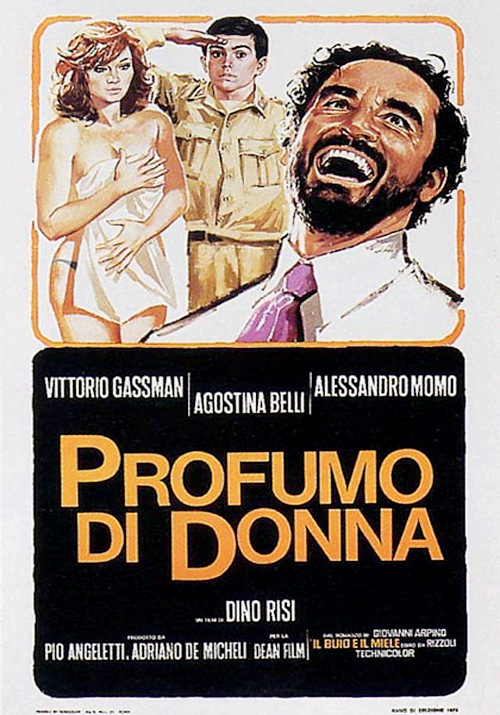
Suicide is a powerful plot device, but perhaps Al Pacino is not fully culpable in this shameless rip-off of McLean Stevenson’s character. Scent of a Woman is a remake of the 1974 Italian film, Profumo di Donna (which actually involves a suicide pact between the “Frank Slade” character and a comrade who was terribly injured in the same wartime incident). That film was released on December 20, 1974—less than eleven months after “The Chosen People” first aired.
 
Now, I’m not sure of the exact lag time that M*A*S*H experienced from original air date on CBS to broadcast in Europe—in England, for example, the pilot episode premiered eight months after it debuted in the United States—but such lag time would most likely put the Italian airing of “The Chosen People” episode at the time of the writing or filming of Profumo di Donna. So it’s a good bet that director Dino Risi “borrowed” heavily from Henry Blake’s popular on-screen antics. And even if Blake’s hoo-hah expression was not among the elements nicked by Risi*—which would mean that Pacino went directly to the source for his catchphrase—those character traits and plot devices borrowed for Profumo di Donna then were annexed by Pacino nearly two decades later and ridden to an Academy Award—not to mention into one of the most oft-used sound bites in the history of film.  
 
* I simply do not know if the expression appears in the original film—to a non–Italian-speaking viewer, every other word in an Italian film sounds like hoo-hah.

It is not known what McLean Stevenson—who died in 1996—thought of Pacino winning the Academy Award with a performance built on Henry Blake’s back, but, even though he never appeared in a film during his career, McLean Stevenson sure deserved a scent of that Oscar...

(Image of Al Pacino copyright Universal Pictures; Image of M*A*S*H copyright CBS.)

Saturday, April 20, 2013

Was Hernando Roy's Great-Great-Granddaddo?

Normally, I wouldn't think that Emergency!'s Roy DeSoto could possibly be a descendant of 16th-century explorer Hernando de Soto. After all, Roy DeSoto exhibits no Spanish or Hispanic features whatsoever beyond his surname. More tellingly, as a paramedic, he devoted his career to saving lives, whereas de Soto the conquistador left a legacy of violence and death during his tangles with the native peoples of what was to become the American Southeast.*

* Interestingly, Roy DeSoto's partner, John Gage, mentioned himself in one episode as a Native American—yet, to my recollection, at no point during the series' six-season run was he enslaved by Roy DeSoto or infected with smallpox.

Still, tantalizing historico-cultural evidence exists, most readily in the undeniable similarities of their headgear.

Throughout civilization, the helmet has, perhaps more than any other item of apparel, defined a man's nationality and stature, whether he be a Roman centurion, a Viking warrior, an English Roundhead, etc. Even with five centuries standing between de Soto the conquistador and DeSoto the paramedic, their helmets are virtually identical. Yes, Hernando's has a sharp, pointed brim whereas Roy's is gently rounded so as not to poke out the eye of a victim he may be carrying to rescue. And a paramedic would never gild his helmet with gold or festoon it with feathers unless his union was unusually powerful. But the firefighters' helmet is unlike any headgear now extant in the Americas. Nothing else truly resembles it. Thus, it is doubtful that such a unique helmet could have been designed independently in North America during modern times when de Soto and his like were already spreading their influence across the New World, including Station 51's L.A. County, which, of course, was settled by de Soto's brethren. 

I've made a strong case so far. Admittedly, however, I'll need more empirical evidence before I can prove beyond doubt lineage between these two pivotal figures of their respective centuries. So I'd better get down to the American Southeast and start digging.

Or get over to Best Buy and pick up Emergency! on DVD...

Thursday, April 18, 2013

W-A-C-K-O...and "Wacko" Was Its Name-O

This is the cover page of an article in the journal Deviant Behavior. 2000;21(6):489-517.

I always though deviant behavior applied only to eating the bingo chips. Who knew the freakin' game, itself, was wacked?
 
(Cover page copyright Taylor & Francis.) 

Monday, March 18, 2013

Move Over, Grover...and Let Morgan Take Over

Grover Cleveland is well known as the only Chief Executive to serve non-consecutive terms, which he did as the 22nd president, from 1885 to 1889, and the 24th president, from 1893 to 1897.

Now, hes got company...

In the first real blockbuster of 2013, Olympus Has Fallen, Morgan Freeman portrays Speaker of the House Allen Trumbull. When President Asher is taken hostage by North Korean terrorists and held in the bunker of the White House, Trumbull assumes the role of Acting President of the United States.*

* I do not know what happened to the Vice President that he was stepped over in the chain of succession, because I have not seen the filmalthough I hear the popcorn is subpar.

Freeman previously portrayed President Tom Beck in 1998s Deep Impact.

Okay, as implied by the Twenty-fifth Amendment of the U.S. Constitution and set in precedence several times since its ratification, Morgan Freeman’s term as Acting President is not recognized as a formal, numbered presidency—as were, of course, Grover Cleveland’s non-consecutive terms—but as far as the martini-clouded judgment of Mount Drinkmore is concerned, it’s legit enough for this post.

Thus having irrefutably—straight up with one olive—established Morgan Freeman’s non-consecutive presidencies...

Sure, thanks to his presidencies being fictitious, Morgan Freeman never got bogged down in such cinematically mundane crises as tariff issues, economic panics, and thorny questions of colonial annexation—as did Grover Cleveland—but Freeman still was under tremendous pressure to remember his lines, do promotional press junkets for the movie, and keep himself from becoming obese and bushily mustachioed.


Yet Morgan Freemans remarkable, on-screen political achievements dont end there: As Speaker of the House Trumbull fifteen years after he was President Beck, Freeman joins John Quincy Adams as the only former presidents to serve as members of the House of Representatives, which Quincy Adams did from 1831 to 1848.

A further link between the two men is that Morgan Freeman portrayed the freed slave, Theodore Joadson, in the film Amistad, which, in part, retells John Quincy Adams successful 1841 defense of the mutinous slaves aboard the Amistad. (Even further, Morgan Freemans surname, itself, echoes Quincy Adams work as an abolitionist.)

Yes, Morgan Freeman has proved himself a titan of celluloid American politics. And still at the top of his game as a busy Hollywood actor, the 76-year-old Freeman has time and opportunity to become the only former president to serve in both houses of Congress, or perhaps even serve an unprecedented third non-consecutive term as Commander-in-Chiefa landmark achievement of which Freemans agent will hopefully possess enough savvy to be aware.

(Image of Deep Impact copyright DreamWorks Pictures; image of Olympus Has Fallen copyright Millennium Films.)